lab.refslund.ai · Skills exhibition

One skill, one piece.

Each piece takes a single skill and pushes it as far as it goes. The combinations come after. Nothing runs until you press it, and one piece runs at a time.

32 of 32 open

One skill each

One skill carries each piece. Plain HTML, CSS and JS are only the carrier.

Still from One Breath
01

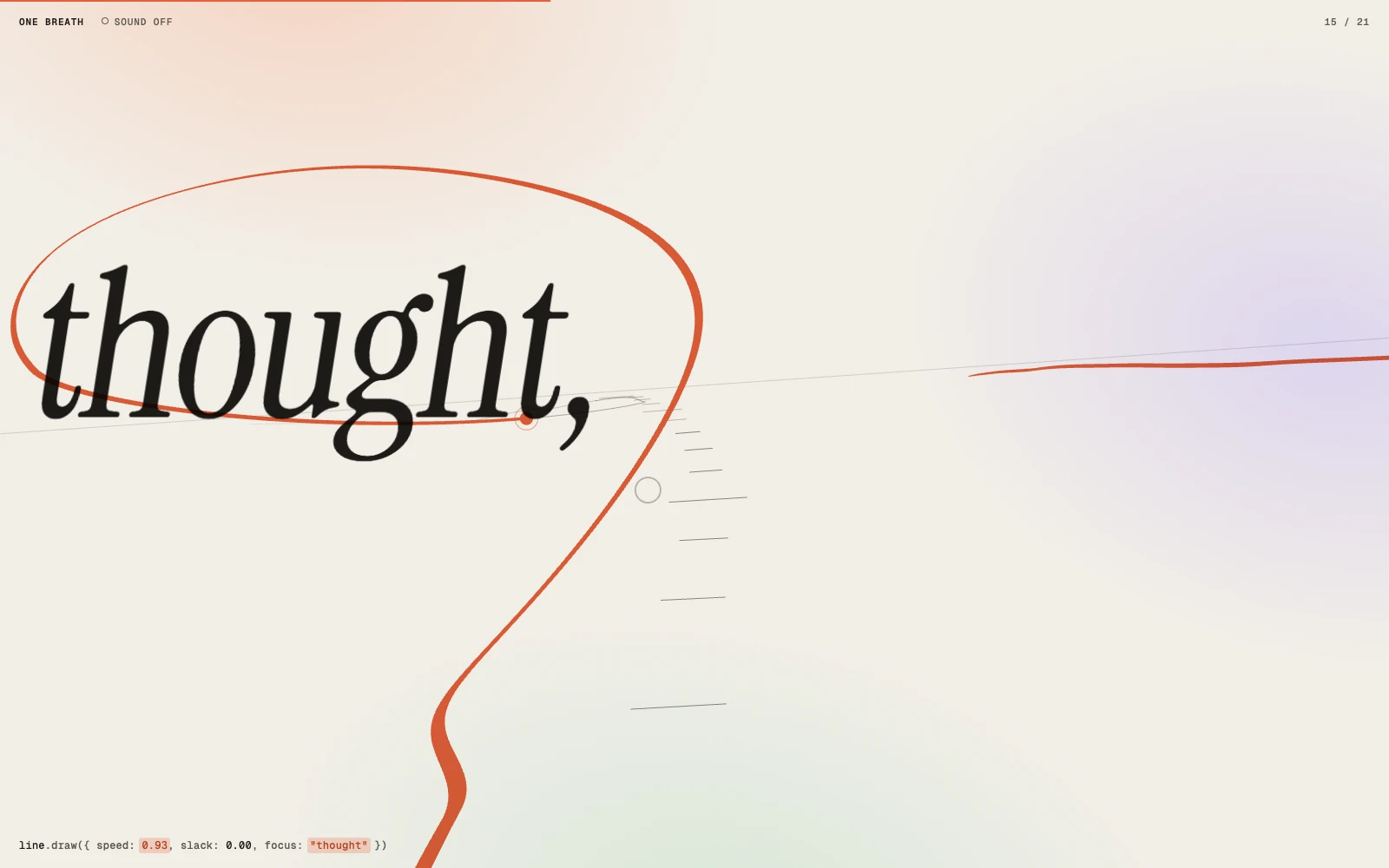
One Breath

interactive-webSound

One sentence stands in a paper world; your scroll pulls a single coral line through all 21 words without lifting it.

Try
Scroll slowly, then fast. Tap the line. Sound on.
Made with
plain HTML, CSS and JS, no library (own tween and spring engine on one clock) + 5 more
Open alone

Worked

  • Scroll scrubbed by two followers (0.11 s head, 0.30 s camera) feels like pulling a line with weight.
  • Scroll speed is written into the line: fast draws it thin and leans the type, slow draws it thick.
  • The last move turns the whole ride into one drawing with the sentence set beside it.

Did not work

  • Words on alternate sides of the route read out of order in a single still.
  • The sound was measured (level, peak, silence at rest), never listened to.
  • The pluck wave is easy to miss on a phone; a tap far from the line gives a ring and nothing else.

Made with

  • plain HTML, CSS and JS, no library (own tween and spring engine on one clock)
  • Canvas 2D + DOM text, CSS scroll-driven animations
  • Web Audio API for the sound (no library, no audio file)
  • Instrument Serif and Geist Mono (OFL)
  • motion-lab render.mjs with Playwright 1.64.1 (film stills, poster, live checks)
  • ffmpeg 9.0.2, cwebp
Still from Temper
02

Temper

web-3d

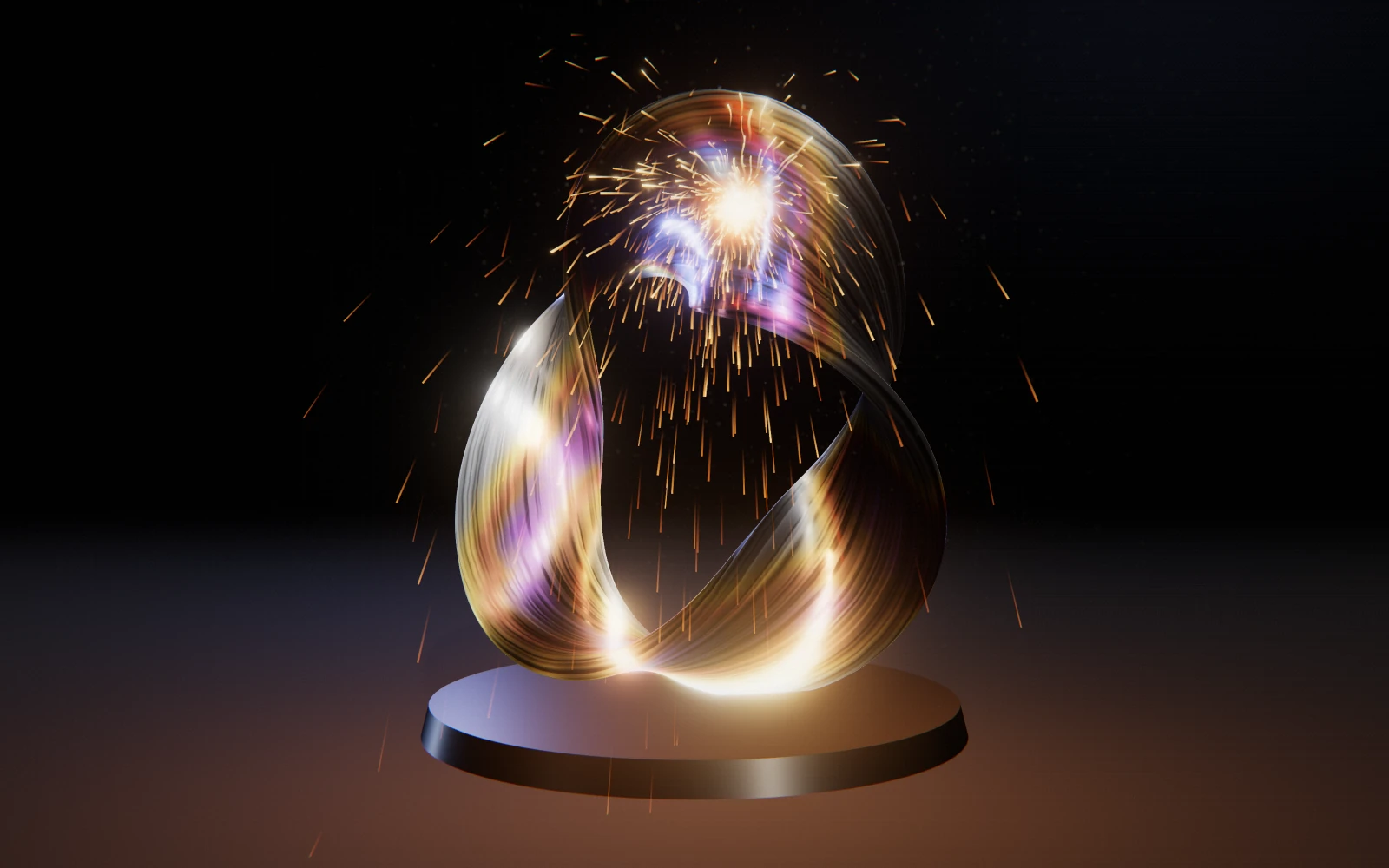
A twisted band of brushed steel: your light heats it to a glow, throws sparks and leaves temper colours that fade in seconds.

Try
Hold the light still, then draw slowly
Made with
three.js 0.187.0 (r187, WebGL2) + 4 more
Open alone

Worked

  • Heat as a closed-form sum over the light's last 64 positions: the steel remembers, yet every frame is a pure function of t.
  • Thin-film iridescence driven per pixel by that heat gives real temper colours: straw, bronze, purple, blue.
  • An own black studio with four soft boxes through PMREM makes dark steel with long streaks; RoomEnvironment made it milky.

Did not work

  • The skill's renderer opens file://, where a vendored import map is blocked; stills needed an own http server and script.
  • Quality steps from rAF timing, then from a mean GPU probe, walked a busy machine to 0.8x while a frame cost 4 ms.
  • Frame rate is measured only uncapped in headless Chromium (143 fps at 2880 x 1800, M5 Max); no real screen or phone was measured.

Made with

  • three.js 0.187.0 (r187, WebGL2)
  • own GLSL in MeshPhysicalMaterial.onBeforeCompile and ShaderMaterial
  • three addons 0.187.0: EffectComposer, RenderPass, UnrealBloomPass, OutputPass, ShaderPass
  • Playwright 1.64.1 with headless Chromium 158 (stills, checks, frame rate)
  • cwebp 1.6.0 (poster)
Still from Calibre 17, Taken Apart
05

Calibre 17, Taken Apart

technical-figures

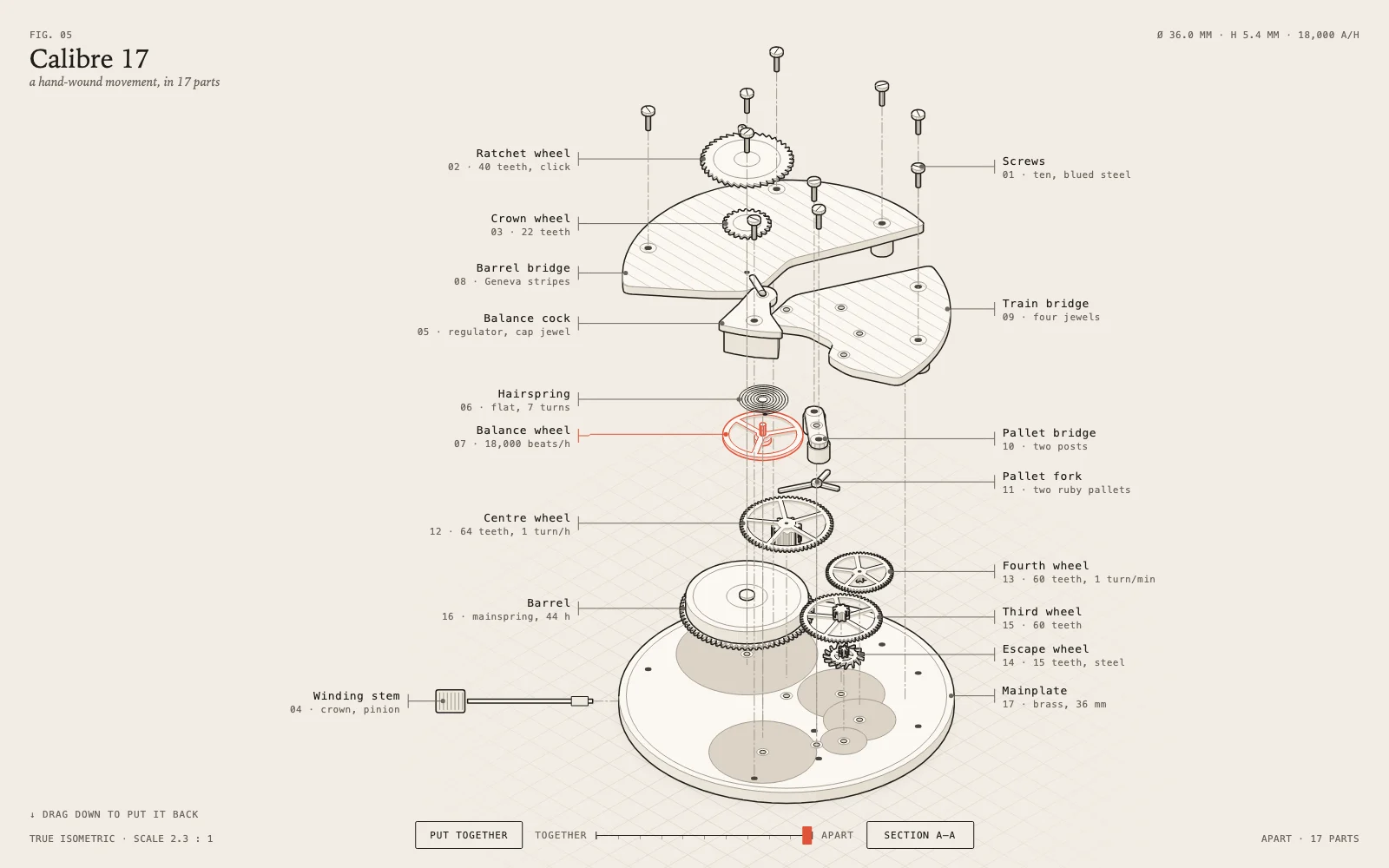
A made-up watch movement in true isometric line: it runs, comes apart in a watchmaker's order under your hand, and opens in section.

Try
Drag up to take it apart, then press Section A–A
Made with
technical-figures 1.0.0 (drawing rules, part model, reveal numbers; engine grown from templates/figure.js) + 4 more
Open alone

Worked

  • One solid for everything (a plan outline pushed up, with holes) drew 17 parts and 10 screws in 527 paths from 50 kB of code.
  • The hand sets one number; order, stagger, camera, axes and callouts all follow it, so apart and back never go out of step.
  • A cutting plane that faces the viewer squarely gives true-shape hatched faces with no 3D library.

Did not work

  • On a phone the 17 callouts shrink to numbers with one caption; the names do not fit beside the stack.
  • Hidden lines are drawn only where a wheel sits under a bridge, not solved for every part behind every other.
  • The section redraws every solid: about 18 ms of script a frame at 1440 wide while the plane moves.

Made with

  • technical-figures 1.0.0 (drawing rules, part model, reveal numbers; engine grown from templates/figure.js)
  • Inline SVG and plain JavaScript, no library, no font files (system mono and serif stacks)
  • Node 26.0.0 (export-svg.mjs, the same code as the page)
  • Playwright 1.64.1 with Chromium, motion-lab's install (stills and checks only)
  • cwebp (poster)
Still from Witness, a kiln's firing log
08

Witness, a kiln's firing log

claude-design

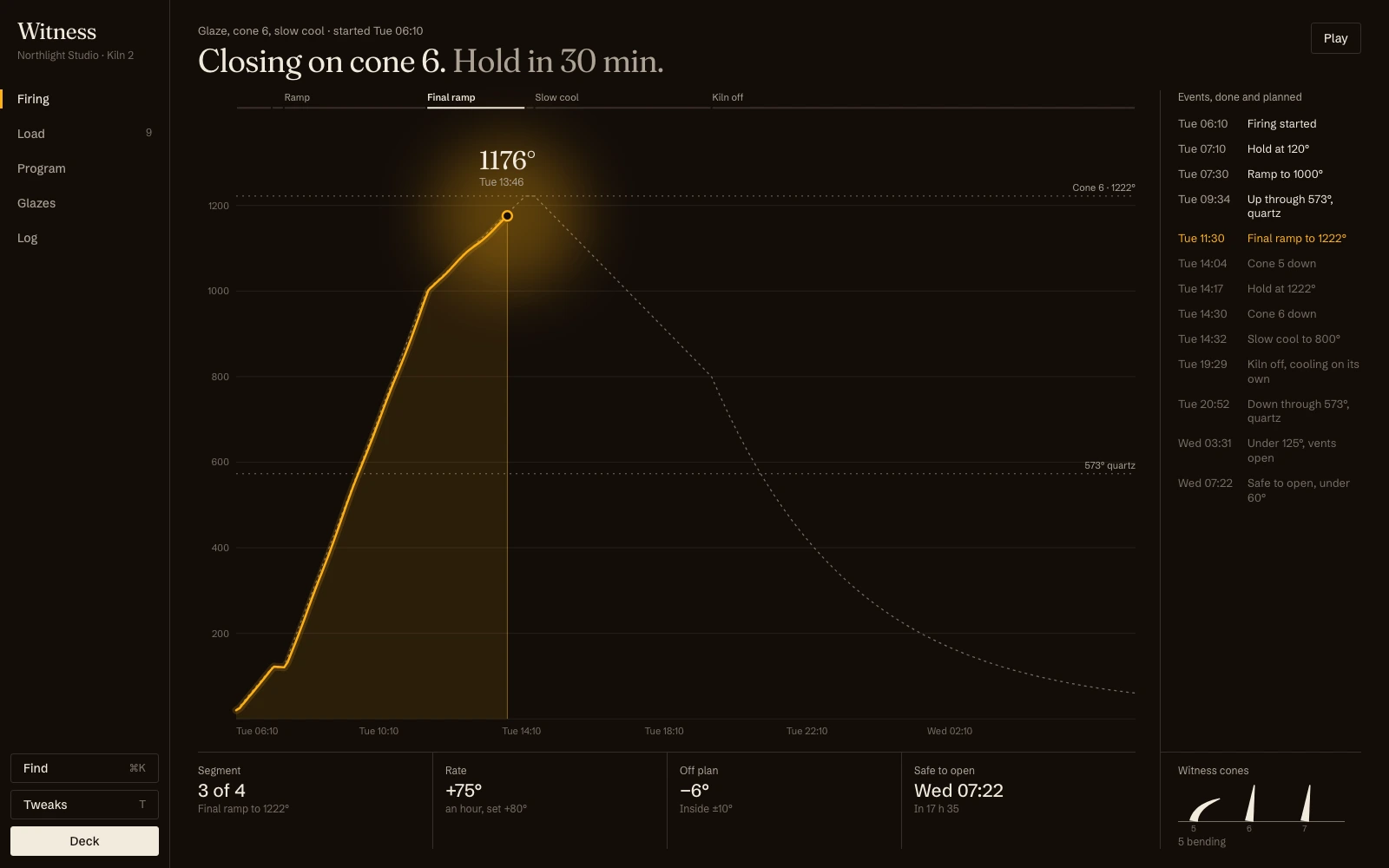
A working prototype of a made-up kiln log: five screens lit by the kiln's own heat, and a deck that holds the live product.

Try
Drag the curve, then press Deck
Made with
Hand-written HTML, CSS and JavaScript, no framework + 7 more
Open alone

Worked

  • One surface named per screen gave seven different compositions from one small system.
  • The slop audit, scored before any fix, caught two accent rails and one wrong-surface slide.
  • The deck shows the live prototype inside the slide, through a shared-element transition.

Did not work

  • Labels that follow the curve head collided with the plan line three times before a placement test.
  • The live prototype inside a slide is drawn at about 62 %, so its own text is under the deck's 24 px rule.
  • On a 390 px phone the glazes are still a sideways carousel: an index names all four, but only two compare at once.

Made with

  • Hand-written HTML, CSS and JavaScript, no framework
  • View Transitions API (same-document, with a plain-swap fallback)
  • Fraunces variable 5.3.0 (@fontsource-variable, OFL)
  • Schibsted Grotesk variable 5.3.0 (@fontsource-variable, OFL)
  • Python 3.9.6 (src/build.py) and Pillow 11.3.0 (contact sheets)
  • playwright-core 1.65.1 with Chromium headless shell build 1254 (screenshots, walk)
  • cwebp 1.6.0 (poster)
  • claude-fable-5-2
Still from Floating Ink
12

Floating Ink

p5js

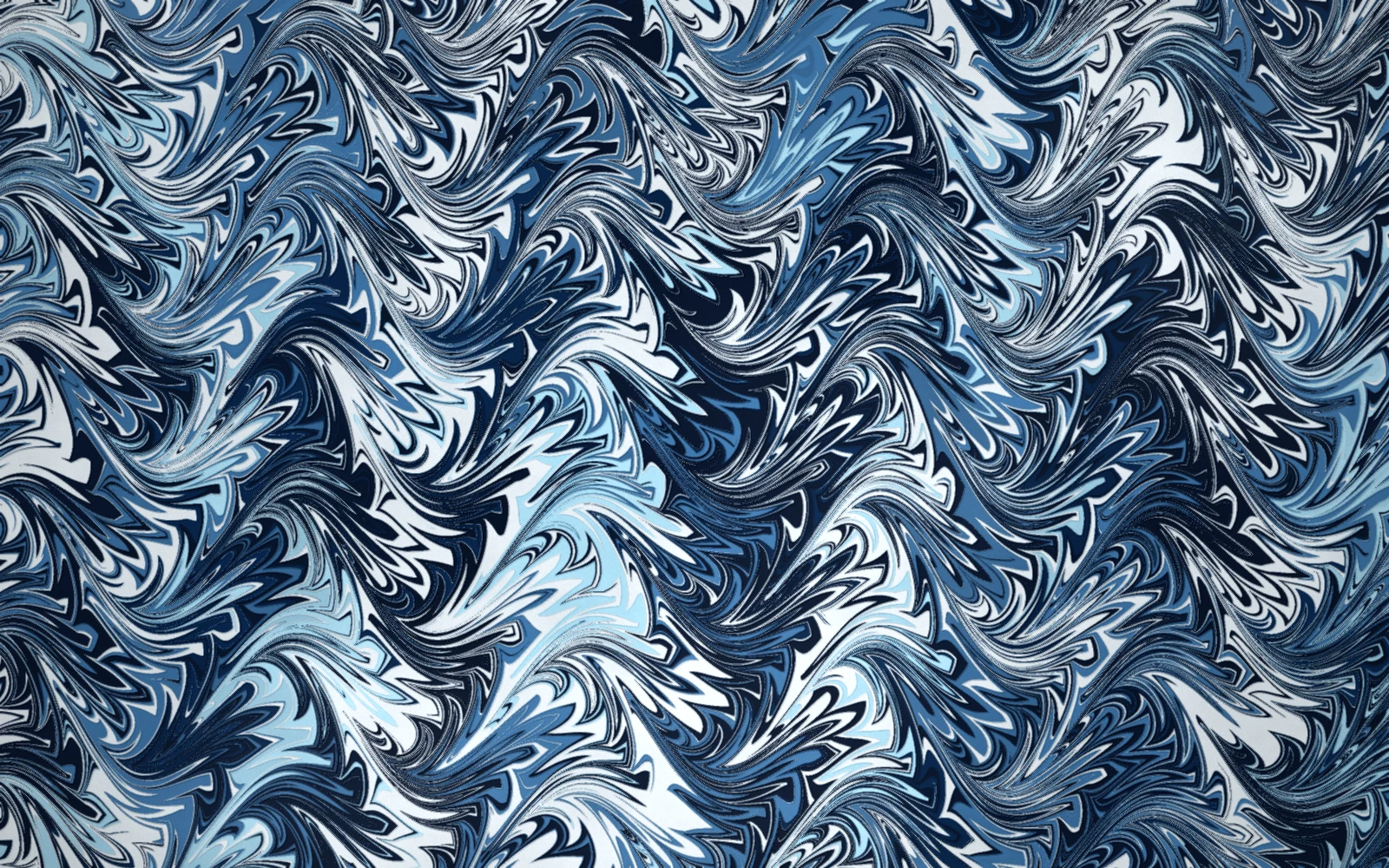
A bath of floating ink: every seed marbles a new sheet, you comb it and pour rings by hand, then pull it as a print.

Try
Drag to comb, hold to pour rings, then pull a print
Made with
p5.js 1.11.3 (WEBGL, createShader, createFramebuffer, instance mode) + 4 more
Open alone

Worked

  • One list of moves walked backwards per pixel in a shader: the same plate on screen, on a phone and as a 3200 px poster.
  • Seven marbling families and eight palettes from one seeded generator; combed, stone and veined sheets read as real marbled paper.
  • Hand play in one shader path: drag is a stylus, a held finger pours rings of ink and clear water, one undo takes a pour back.

Did not work

  • Not tried on a real phone or measured on a real GPU, only headless Chrome with touch events.
  • Suminagashi leaves about a third of the sheet bare, and a print at 1:1 shows a few faint straight edges between dark stones.
  • PNG only: no print PDF with bleed (that needs another skill).

Made with

  • p5.js 1.11.3 (WEBGL, createShader, createFramebuffer, instance mode)
  • GLSL ES 1.00 fragment shaders, hand-written
  • Fraunces 400 and IBM Plex Mono 400 (@fontsource 5.1.1, OFL)
  • puppeteer-core 23.10.4 with Google Chrome (checks only)
  • cwebp (poster)
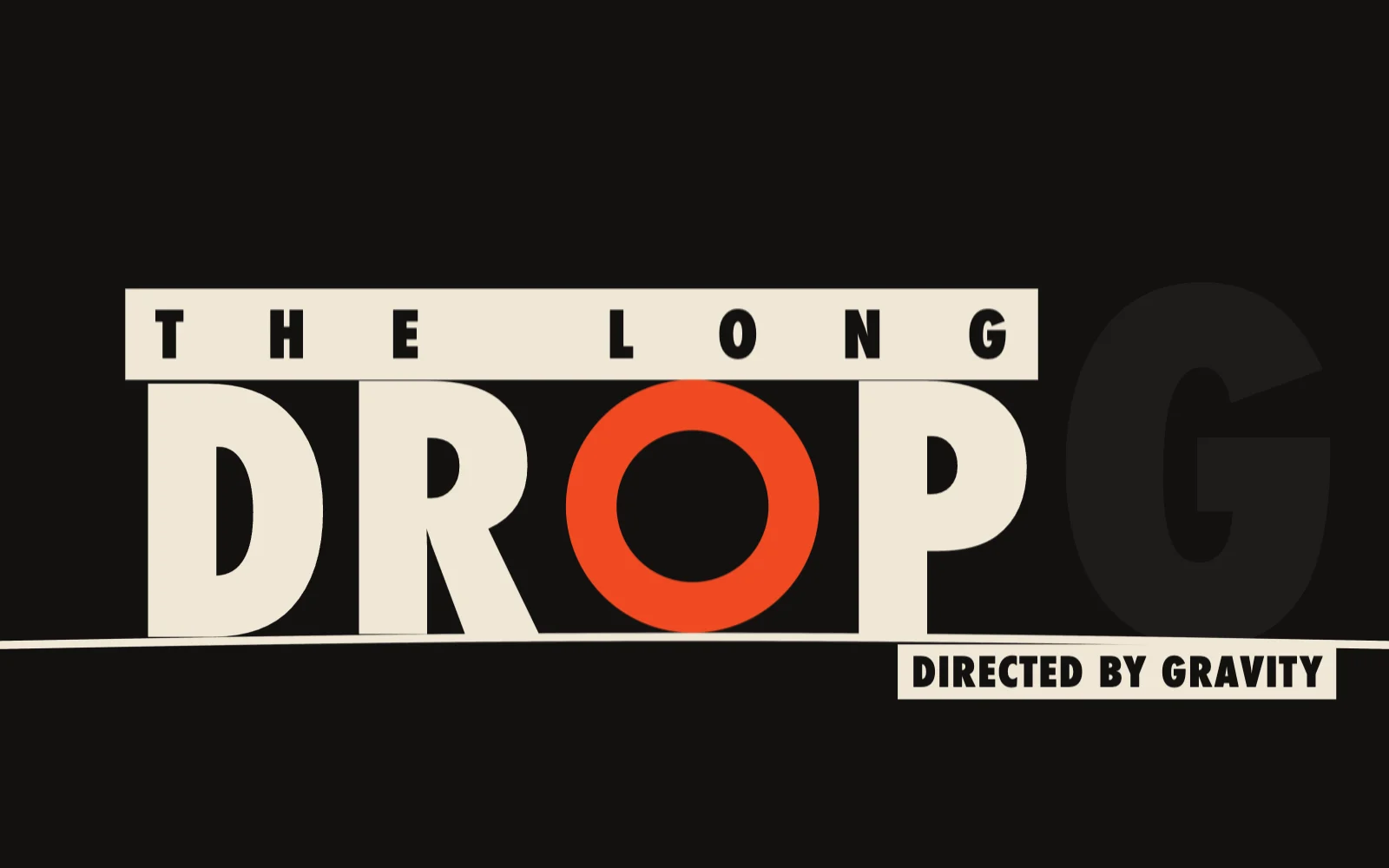
Still from The Long Drop
06

The Long Drop

motion-labSound

The 30-second title sequence of a film that does not exist: a red ring falls thirteen floors, its cuts and landings on the beat.

Try
Press the ring; drag the floor line to scrub
Made with
motion-lab render.mjs (Playwright 1.64.1, headless Chromium, 8-16 subframe motion blur) + 4 more
Open alone

Worked

  • One timeline file drives picture and score, so every cut, pluck and landing shares a frame; all 6 cuts sit on their frames.
  • Weight as numbers per object (gravity frames, squash, settle Hz) and a floor line that carries every landing as a wave.
  • The ending became an event: the floor tears and the O falls out of DROP, and the player's ring returns into the empty slot.

Did not work

  • The first full render's last drop only repeated an earlier squash; seen on frames of the encoded film, fixed by re-rendering 153 frames.
  • render.mjs has no resume; a dead worker meant a full restart until renders went by --from/--to ranges.
  • Four hits inside dense bars can only be located at a 4 dB onset threshold, so their +1 frame lag is not proven.

Made with

  • motion-lab render.mjs (Playwright 1.64.1, headless Chromium, 8-16 subframe motion blur)
  • motion-lab sfx.mjs and beats.py (coded score, 96 BPM, -14 LUFS)
  • Canvas 2D, Futura Condensed ExtraBold (macOS system font, baked into the frames)
  • Node 26.0.0, ffmpeg 9.0.2 (H.264 CRF 18, AAC 192k), cwebp 1.6.0
  • Google Chrome 157 (player checks)
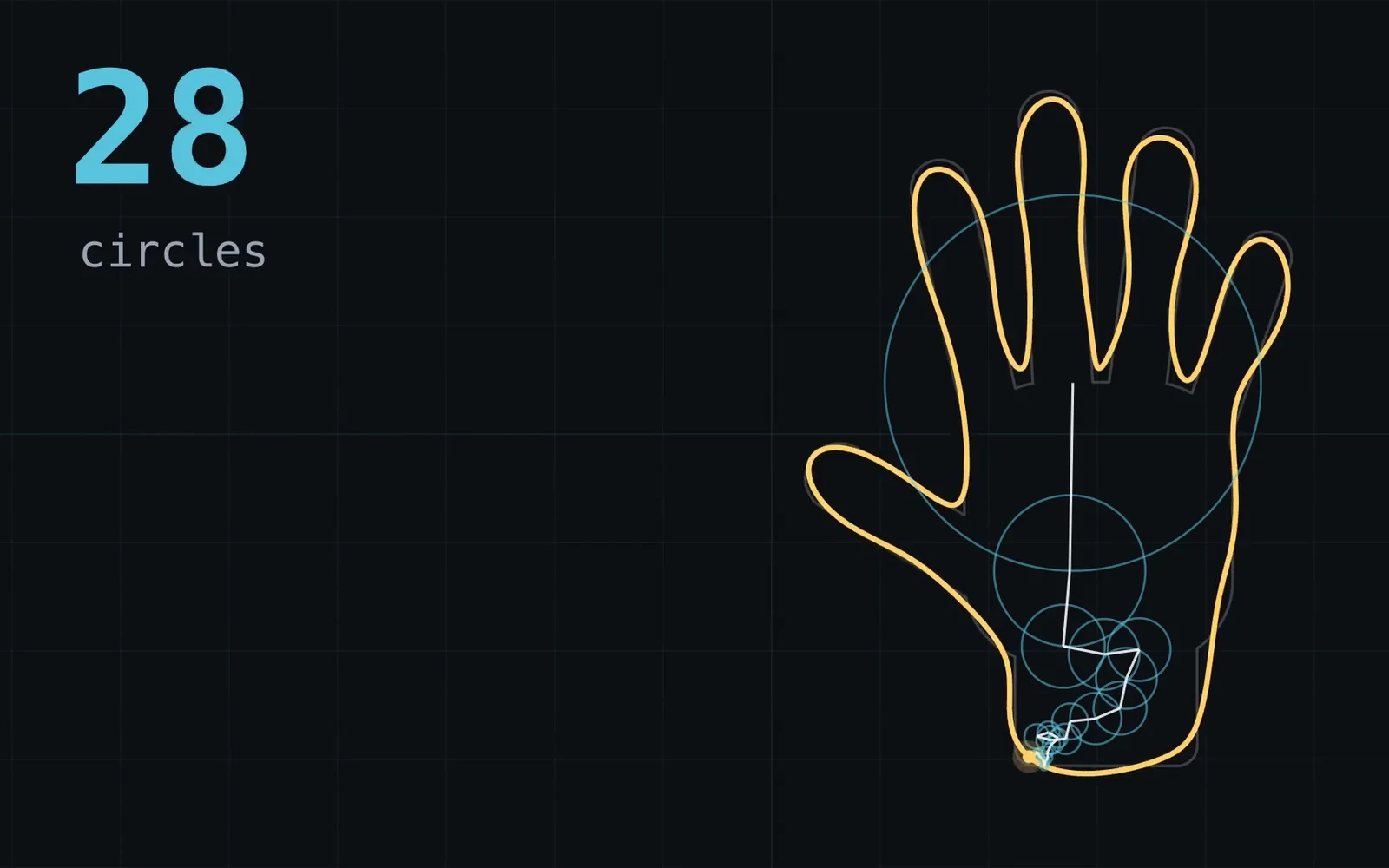
Still from A Hand Made of Circles
13

A Hand Made of Circles

manim-video

A silent minute: turning circles, big and slow to tiny and fast, draw a hand, then become a row that can draw any outline.

Try
Press play; jump by chapter or scrub
Made with
Manim Community 0.22.1 + 4 more
Open alone

Worked

  • One ValueTracker drives 100 chained circles, the drawn line and the camera together.
  • The camera rides the pen at 6.8x so the tiny fast circles are seen laying down a fingertip.
  • Blending two series on the same speeds morphs the open hand into a two-finger sign.

Did not work

  • Text stroke and lines grew into ropes under zoom until scaled by frame width.
  • A centred zoom target ran into the pinned caption; it now sits right of centre.
  • The row's last 80 circles are too small to read and show as a thread.

Made with

  • Manim Community 0.22.1
  • Python 3.12
  • NumPy (FFT)
  • ffmpeg 9.0.2 (H.264)
  • plain HTML/CSS/JS player
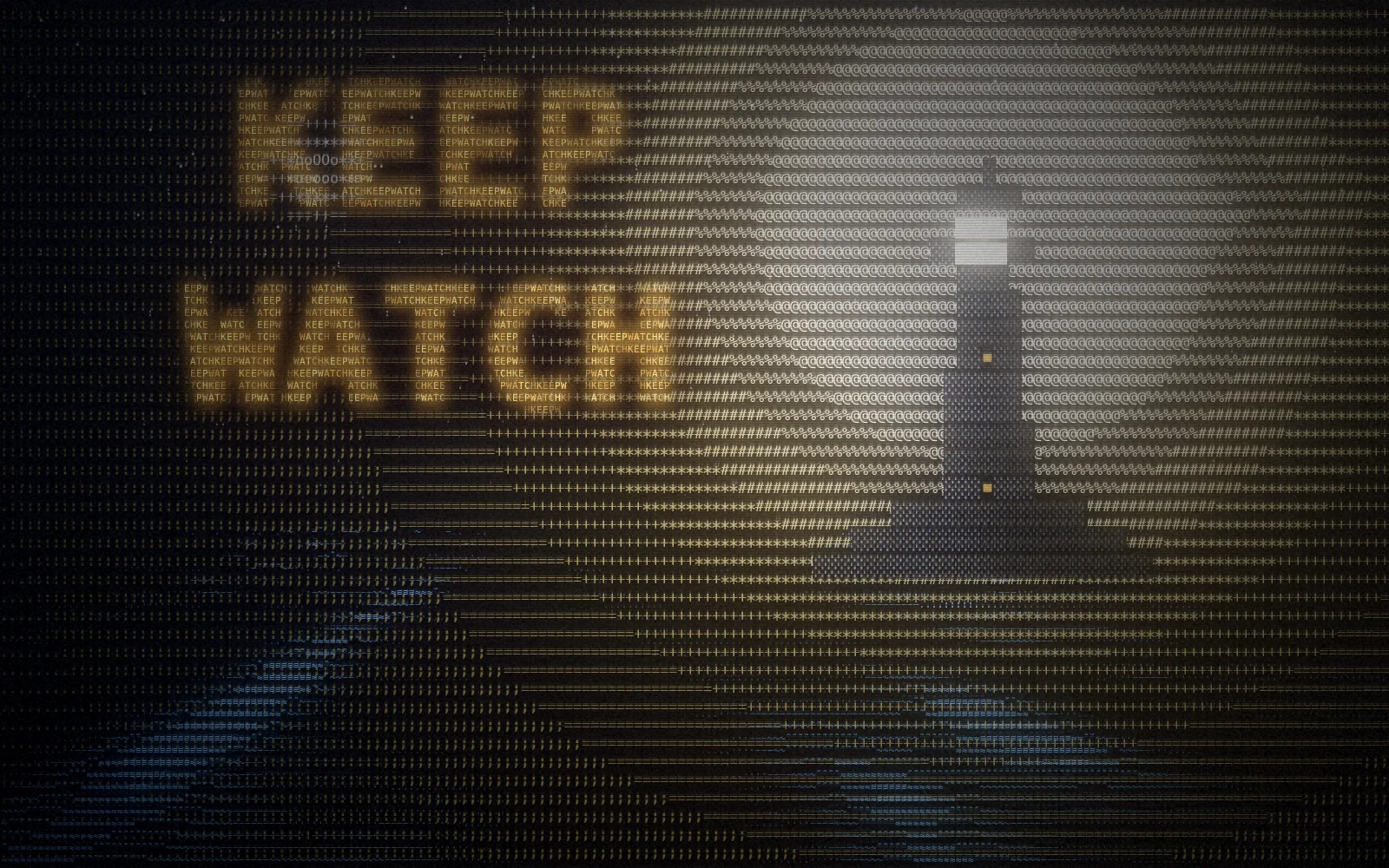
Still from Night Watch
14

Night Watch

ascii-videoSound

A 32-second ASCII film: a lighthouse keeps watch through a storm, its beam, rain and thunder driven by the sound.

Try
Press play, sound on
Made with
Python 3.14.9 (src/render.py, src/sound.py, src/build_page.py) + 5 more
Open alone

Worked

  • Sound made in the same script and analysed with the skill's FFT pass put every flash on its thunder crack.
  • Three grid sizes screened together (water, sky and beam, stone) read as depth.
  • A vectorised glyph-atlas gather rendered the 32 s film in under four minutes.

Did not work

  • Words drawn on a grid of letter glyphs broke into noise twice before a thickened stencil and a backdrop.
  • A beam made only of glyphs read as grey cloud until a pixel-space haze was added.
  • A straight hue blend from night to dawn put a green streak on the sea.

Made with

  • Python 3.14.9 (src/render.py, src/sound.py, src/build_page.py)
  • NumPy 2.5.5 and SciPy 1.18.1 (scene fields, synthesised track, FFT features)
  • Pillow 13.0.0 (glyph atlas from Menlo, blur, poster)
  • FFmpeg 9.0.2 (libx264 and AAC)
  • Hand-written HTML, CSS and JavaScript player, no framework
  • claude-opus-5-5
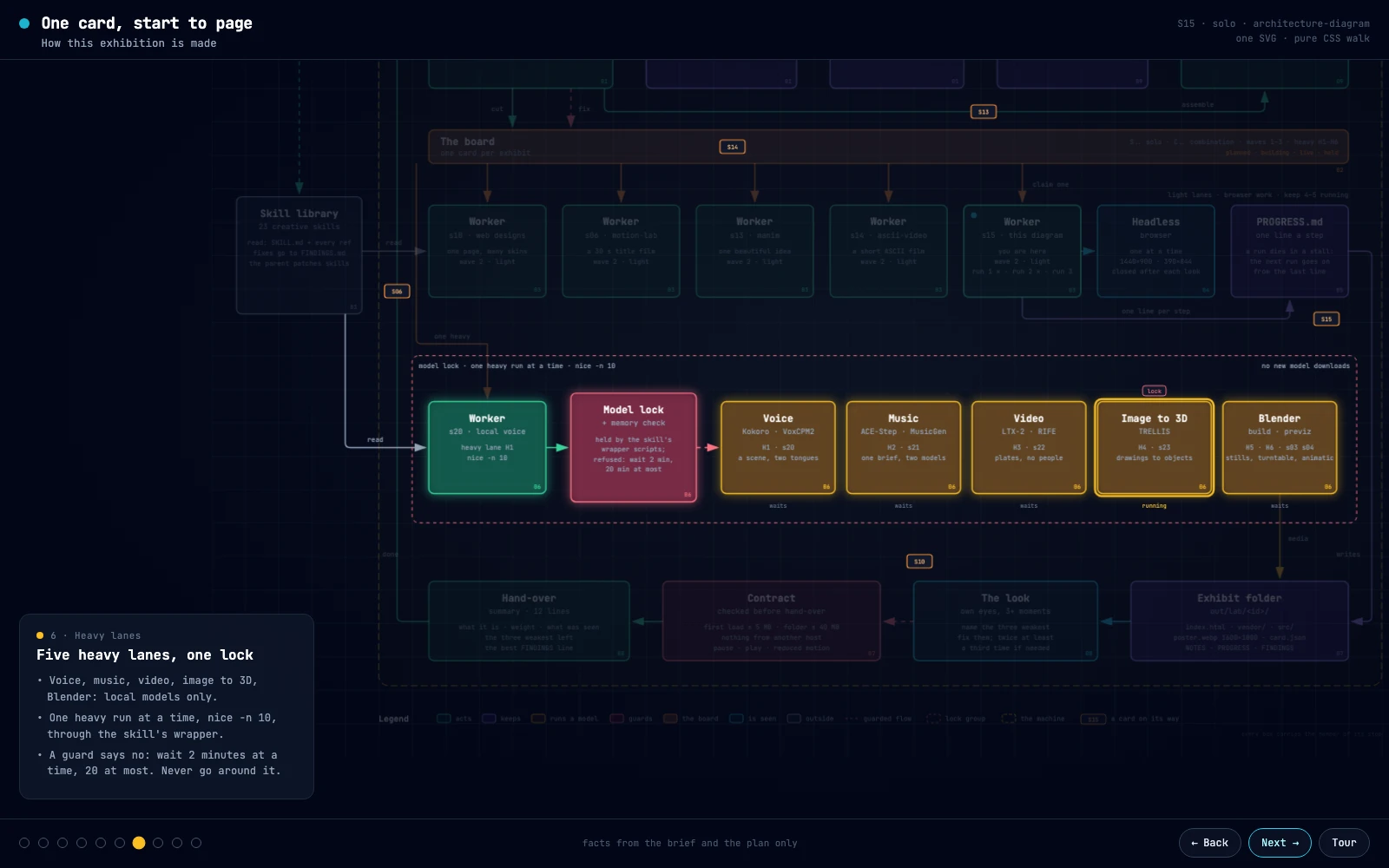
Still from One card, start to page
15

One card, start to page

architecture-diagram

How this exhibition is made, as one architecture diagram you walk in ten stops, with cards riding the arrows and one lock.

Try
Press Next, tap a box, or take the tour
Made with
inline SVG + 4 more
Open alone

Worked

  • The skill's colour grammar reads as types at every zoom: green acts, violet keeps, amber runs a model, rose guards.
  • A whole walk-through camera, keys and tour in CSS alone; the only script is the lab pause carrier.
  • Double rects and arrows-first z-order kept 27 arrows clean under 26 boxes.

Did not work

  • The skill's 7-9 px type cannot be read on a phone overview; it only reads once zoomed to a stop.
  • Stops near the top edge leave empty grid above the diagram on wide screens.
  • The lock's running lane and travelling cards are not dimmed with the rest at a stop.

Made with

  • inline SVG
  • pure CSS (radio inputs, offset-path, container units)
  • JetBrains Mono via @fontsource-variable/jetbrains-mono 5.3.0
  • Python 3.14 build script
  • playwright-core 1.65.1 for screenshots
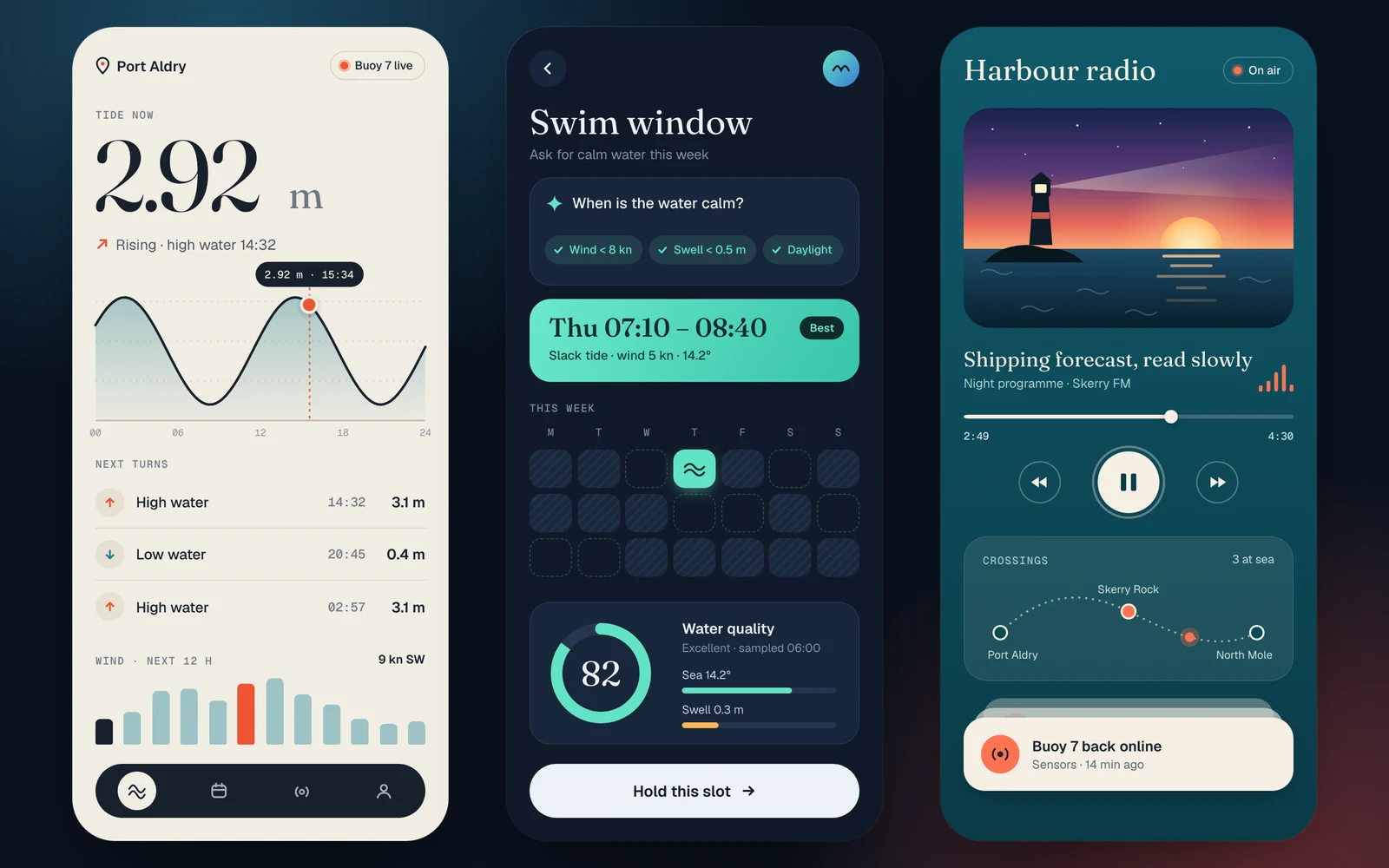
Still from Skerry: a still wakes
07

Skerry: a still wakes

design-to-motion

A flat app showcase still is swept aside by a seam, and the same pixels load in, act out eleven small stories and loop without a seam.

Try
Drag the line: left is the still, right is alive
Made with
design-to-motion skill (Parts A, B, C) + 6 more
Open alone

Worked

  • 97 exported layers rebuild the still at 49.6 dB; text is never retyped, so the moving page is the design, not a copy of it.
  • One pure render(t) on one clock: seam, empty beat, rest and overflow checks all pass on 867 captured frames.
  • The seam makes the skill's work plain: at rest it cannot be seen, only motion gives it away.

Did not work

  • Capture at the skill's 1.333 device scale flickers by 6 levels on a 3-row strip; an integer scale of 2 fixed it.
  • The loop GIF is 3.1 MB already at the skill's lowest frame rate (15 fps); a photo and eleven stories fill the budget.
  • On a phone the seam gives way to a Still/Motion switch; one screen at a time loses the three-up composition.

Made with

  • design-to-motion skill (Parts A, B, C)
  • Playwright 1.64.1 with its Chromium (layer export, deterministic capture)
  • ffmpeg 9.0.2 (H.264 mp4, GIFs, PSNR)
  • cwebp 1.6.0
  • Pillow 11.3.0 (frame checks, contact sheets)
  • Fraunces, Geist, Geist Mono (OFL 1.1)
  • plain HTML, CSS and JS; no library
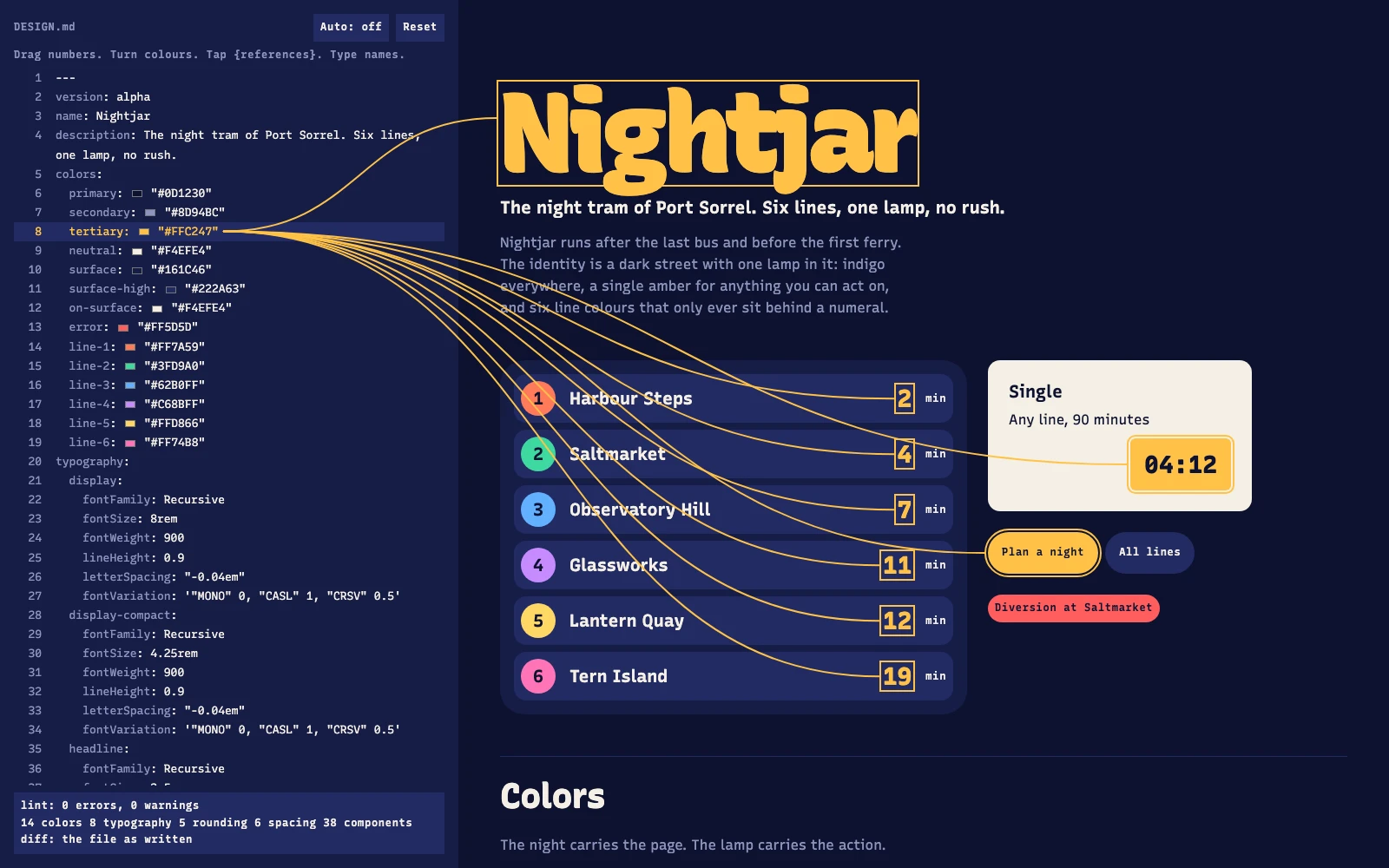
Still from The file draws the page
11

The file draws the page

design-md

A made-up night tram's DESIGN.md sits beside the style guide it draws; change a value and the page, the lint and the diff follow at once.

Try
Drag a number or turn a colour in the file
Made with
@google/design.md 0.4.0 (CLI: lint, diff, export, spec; its linter and Tailwind v4 exporter bundled for the browser) + 5 more
Open alone

Worked

  • The real linter runs in the page in about 5 ms, so every edit is checked for contrast and broken references as it is made.
  • Token references make the threads possible: one line of the file can show everything on the page that hangs on it.
  • The CLI's own Tailwind v4 export is the first rule of the page's stylesheet, written again on every change.

Did not work

  • No export carries components, unitless line height or font axes; the page writes those rules itself from the same file.
  • The spec has no token for layout, motion, borders or breakpoints, so a carrier stylesheet still places everything by hand.
  • It is a style guide: once the threads are understood, the sections under the first view are a plain token sheet.

Made with

  • @google/design.md 0.4.0 (CLI: lint, diff, export, spec; its linter and Tailwind v4 exporter bundled for the browser)
  • esbuild 0.28.2 (the browser bundle, 343 KB)
  • Recursive variable font from @fontsource-variable/recursive 5.3.0 (OFL)
  • Hand-written HTML, CSS and JavaScript, no framework
  • playwright-core 1.65.1 with Chromium headless shell build 1254 (stills, checks)
  • cwebp 1.6.0 (poster), Pillow 11.3.0 (contact sheets)
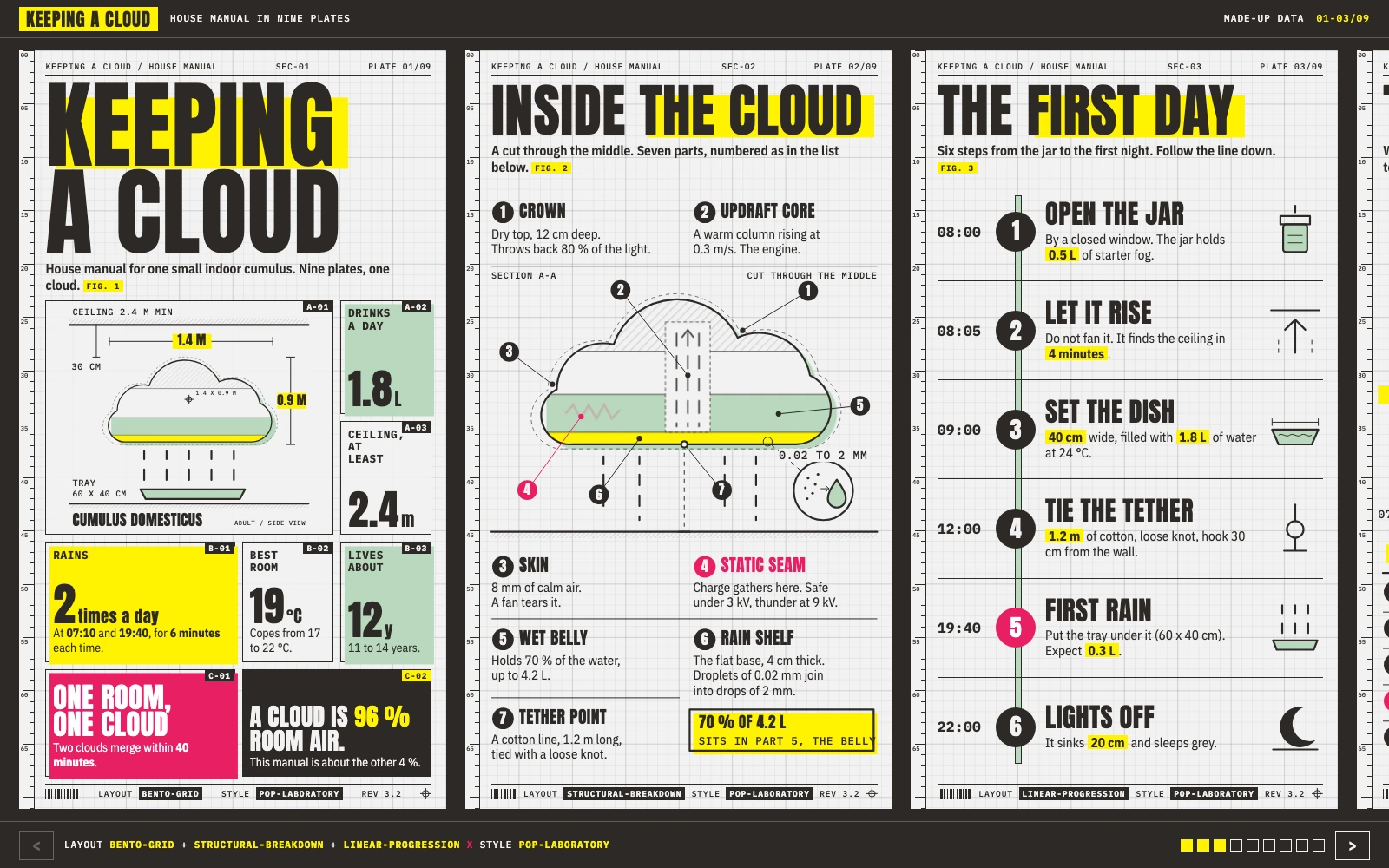
Still from Keeping a Cloud
16

Keeping a Cloud

baoyu-infographic

A made-up house manual for one indoor cloud, told as nine infographic plates: nine layouts of the skill, one style throughout.

Try
Swipe sideways, plate by plate
Made with
baoyu-infographic 1.56.1: nine layout files and the pop-laboratory style file, drawn by hand (its image step was not run, no image model) + 4 more
Open alone

Worked

  • One style file held nine different layouts together: coordinate labels, rulers and one job per colour make it one document.
  • The verbatim rule runs as a script: 283 numbers on nine plates, each one found in the source.
  • Each plate is one self-scaling 9:16 picture, so a plate fills a phone and three hang side by side on a desktop.

Did not work

  • The skill's own picture step needs a hosted image model; it was not run, so these plates are hand-drawn from its files.
  • Plates 6 and 9 are at the edge of what a 390 px screen can carry; the smallest labels are 10.4 px.
  • The line drawings (cloud cut, dishes, knot) are plain; an illustrator or an image model would give them more life.

Made with

  • baoyu-infographic 1.56.1: nine layout files and the pop-laboratory style file, drawn by hand (its image step was not run, no image model)
  • hand-written HTML, CSS (container units, offset-path) and inline SVG
  • Python 3.14 plate generators and number check
  • Anton, IBM Plex Sans Condensed and IBM Plex Mono via @fontsource 5.3.0
  • playwright-core 1.65.1 for screenshots
Still from The Night Board
17

The Night Board

hyperframes-narrated-briefSound

A station departure board reads out one week of a night railway that does not exist, and every flap lands on its spoken word.

Try
Press PLAY, then drag the train along the line
Made with
HyperFrames 0.9.59 (lint, snapshot, render: 1080 x 1920, 30 fps, 1689 frames), GSAP 3.14.2 on one paused timeline + 4 more
Open alone

Worked

  • One cue sheet built from the word times drives the flaps, the caption, 137 sound events and the player's six stops.
  • A stock local voice, one phrase per call: phrase starts exact to the sample; whisper heard the encoded film with 1 stray word in 116.
  • The board is a pure function of time, so a seek, a snapshot and the render give the same frame; 56 s rendered in about 2.5 minutes.

Did not work

  • Kokoro bent phrases of three or four words twice ("dining curse"); three short replies had to become one sentence.
  • The first encoded film wiped the board through rows of question marks and its risk was not red; seen only on encoded frames, rendered twice more.
  • No person has heard the sound: loudness (-16.0 LUFS, true peak -2.6 dB) and the words are measured, the taste of the mix is not.

Made with

  • HyperFrames 0.9.59 (lint, snapshot, render: 1080 x 1920, 30 fps, 1689 frames), GSAP 3.14.2 on one paused timeline
  • Voice Studio 0.5.8 through local-models vs_narrate.sh: Kokoro stock voice bf_emma (mlx-audio), 21 takes, each checked with vs_check.py
  • whisper.cpp 1.9.5, large-v3-turbo q8 (local word times, and a hearing check of the encoded film)
  • Python 3.14 with numpy (bed and all 137 sound events made in code), ffmpeg 9.0.2 (H.264 CRF 22, AAC 160k, two-pass loudnorm), cwebp 1.6.0
  • Barlow Condensed and JetBrains Mono (SIL OFL 1.1), Node 26.0.0, Google Chrome 157 (page checks)
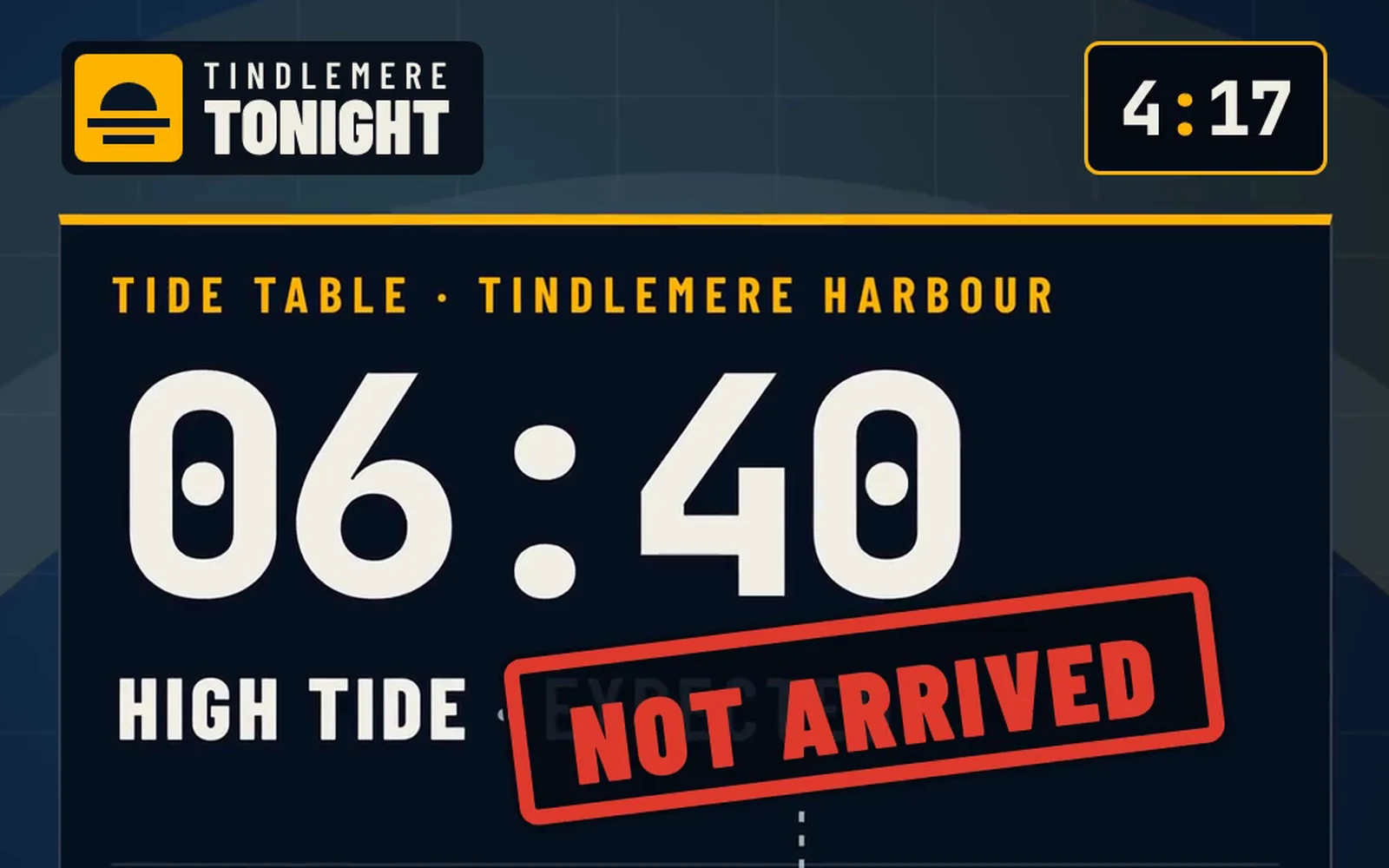
Still from Tindlemere Tonight
18

Tindlemere Tonight

news-parody-briefSound

The 69-second evening bulletin from a town that does not exist, where this morning's high tide did not arrive and has not called.

Try
Press play; drag the ticker band to scrub
Made with
news-parody-brief kit: assemble.py method (edit list, one ffmpeg graph per scene, stream-copy join), shot.py method (headless Chrome to PNG overlays), transcribe.py (local whisper word times and loudness envelope) + 5 more
Open alone

Worked

  • Every graphic lands on its word: cues come from local whisper word times, and after a pause from the loudness envelope.
  • One ffmpeg graph per scene and a stream-copy join: a fix round renders only the changed scenes (two of twelve in 32 s), and all 2070 frames are counted.
  • The player is the show's own furniture: the play button is a lower third, the transport is the ticker band, subtitles come from the edit list.

Did not work

  • No person has heard it: voices, bed and sting are measured (-16.1 LUFS, -1.45 dBTP, whisper hears all 149 words in the final mix), not judged.
  • No face appears: the skill's talking shots and its voices are paid cloud services, so the anchor is a voice over graphics.
  • The first film left the sign-off plate empty for a second and the second put a quote card over the clock face; both were seen on encoded frames and fixed.

Made with

  • news-parody-brief kit: assemble.py method (edit list, one ffmpeg graph per scene, stream-copy join), shot.py method (headless Chrome to PNG overlays), transcribe.py (local whisper word times and loudness envelope)
  • Local voices through vs_narrate.sh: Kokoro bm_george and bf_emma (mlx-audio), one VoxCPM2 designed voice; each take checked with vs_check.py
  • Coded sound in numpy (bed, sting, booms, ticks, wind), mixed to -16.1 LUFS and -1.45 dBTP
  • ffmpeg 9.0.2 (H.264 High, 1080x1920, 30 fps, two-pass 1.05 Mbps, AAC), Pillow, Python 3
  • Barlow Condensed and JetBrains Mono, baked into the frames and in vendor/ for the player
  • Google Chrome (player checks at 1440x900 and 390x844)
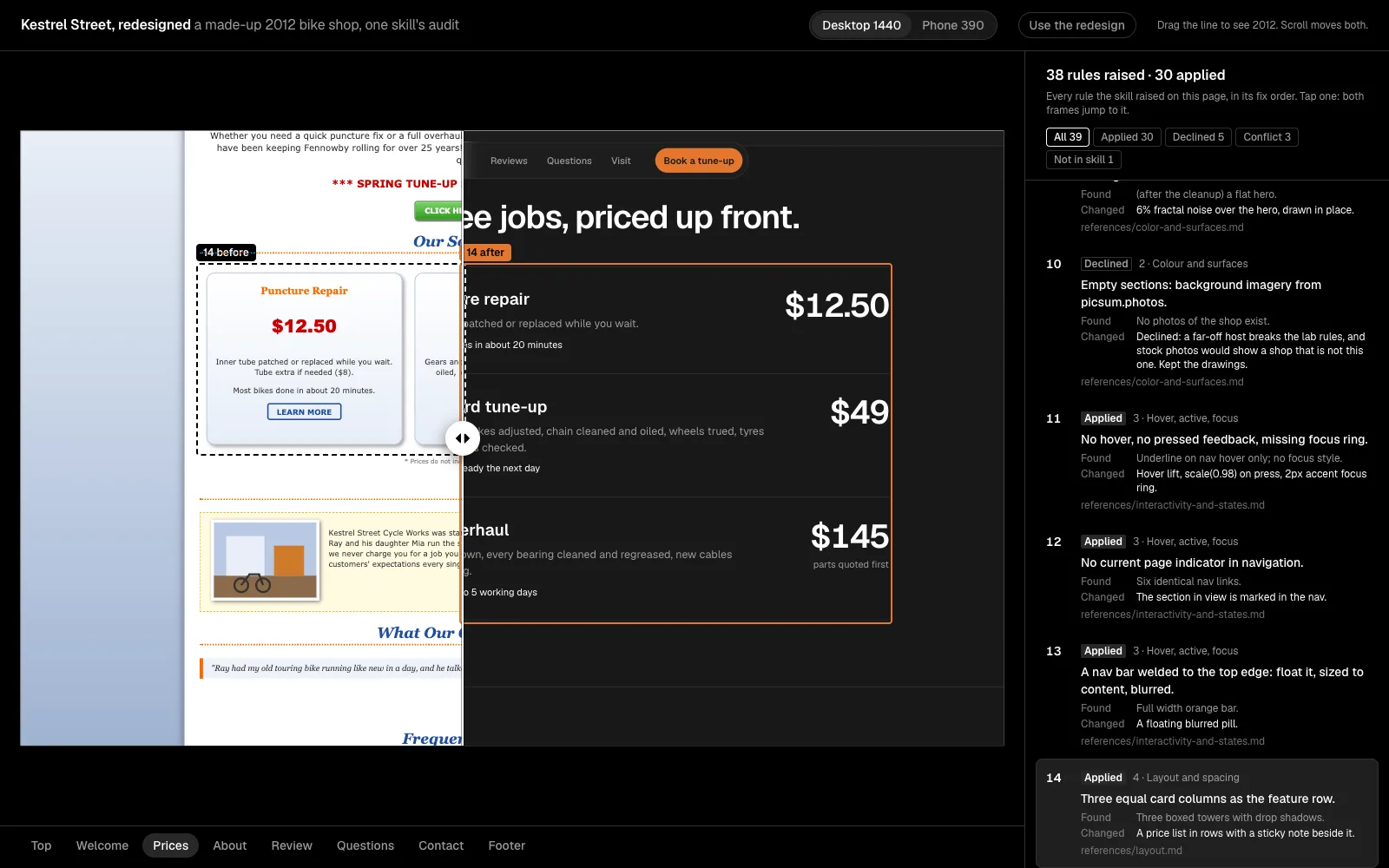
Still from Kestrel Street, redesigned
09

Kestrel Street, redesigned

redesign-existing-projects

A made-up 2012 bike shop page and its redesign, frame-locked side by side, with the skill's 38 rules tied to each change or refusal.

Try
Drag the line, then tap a rule in the list
Made with
plain HTML, CSS and JS + 5 more
Open alone

Worked

  • The fix order and pattern catalogue caught every 2012 cliché, each with a concrete replacement.
  • The risk-reversal rule dug the shop's real promise out of About and put it in the hero.
  • One closed values file gave a coherent system with no guessed numbers.

Did not work

  • Only dark backgrounds exist, so every redesign comes out dark, even a small-town bike shop.
  • Content rules ask for made-up facts: guarantees, odd-digit prices, extra FAQ questions, stock photos.
  • No rule covers a missing viewport meta, the worst phone fault of the old page.

Made with

  • plain HTML, CSS and JS
  • two same-origin iframes, section-locked
  • Geist 1.9.0 (vendored)
  • Phosphor Icons 2.1.10 paths, inline
  • Python 3.14 build script
  • headless Chrome via lab_cdp
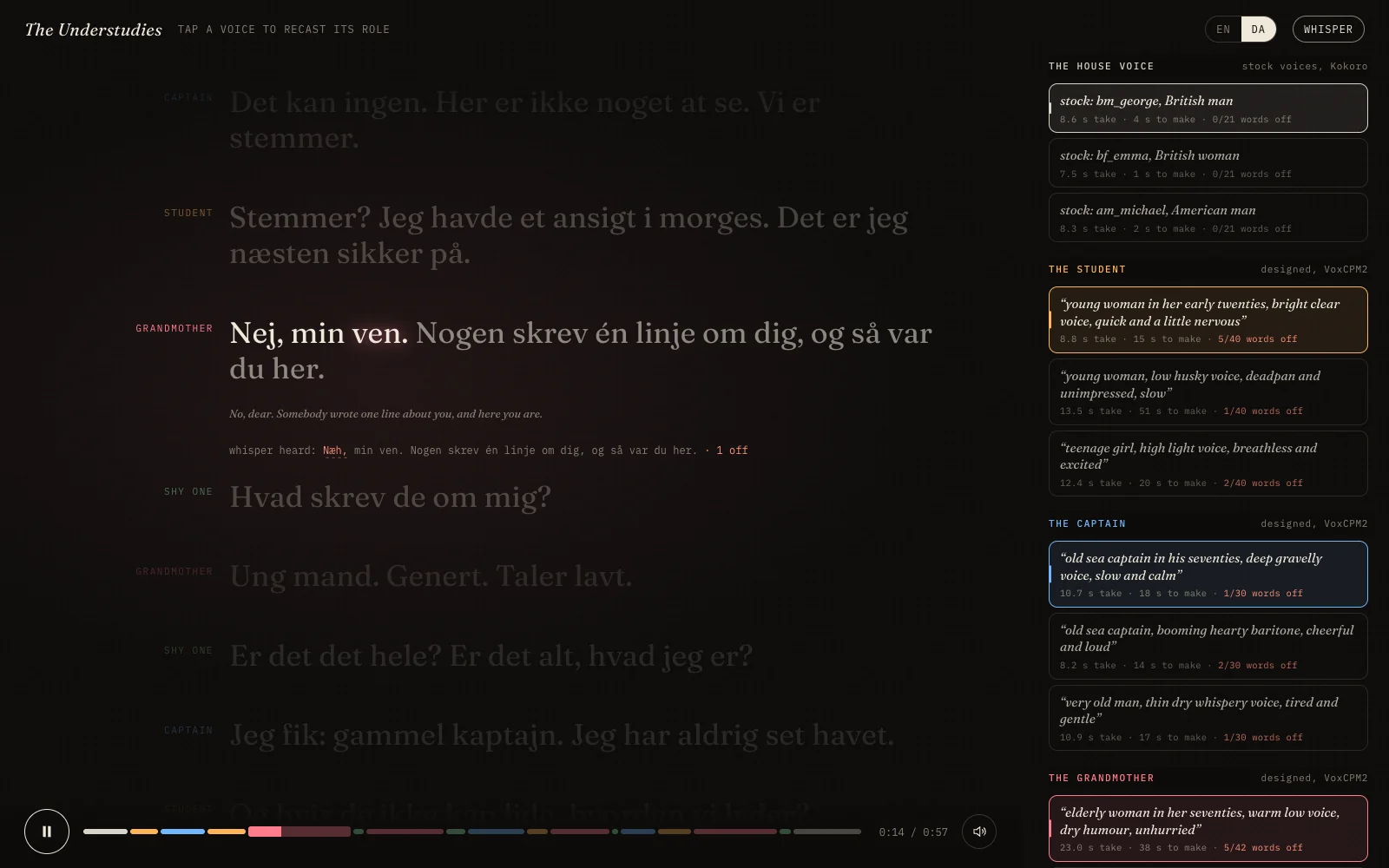
Still from The Understudies
20

The Understudies

local-modelsSound

A one-minute play for four voices made from one written sentence each; tap any understudy and the same line comes back from someone else.

Try
Raise the curtain, then tap a voice to recast
Made with
Voice Studio 0.5.8 on 127.0.0.1:3900 via local-models scripts/vs_narrate.sh and vs_check.py + 7 more
Open alone

Worked

  • 15 voices (12 designed from a sentence, 3 stock) read 17 lines in English and Danish; 27 takes, 298 s, 0 clipped samples.
  • English: whisper heard 444 of 447 words right in 15 takes; all 3 misses are 'speaks' heard as 'speak'.
  • One tap recasts a role and replays the same line from the new voice's own take.

Did not work

  • No person has heard any take: every check is a number or a machine transcript.
  • Danish: whisper heard 25 of 405 words wrong (6 %), mostly the first word of a take and short words ('vi er' as 'via').
  • Loudness spread -15.8 to -20.1 LUFS between takes, though the wrapper aims at -16.

Made with

  • Voice Studio 0.5.8 on 127.0.0.1:3900 via local-models scripts/vs_narrate.sh and vs_check.py
  • VoxCPM2 (openbmb/VoxCPM2, voice design, English and Danish)
  • Kokoro-82M bf16 via mlx-audio (stock voices, English)
  • whisper.cpp 1.9.5, large-v3-turbo q8_0 (transcribed every take and every line slice back)
  • ffmpeg 9.0.2 (ebur128 loudness, line slicing)
  • Python 3.14 stdlib
  • puppeteer-core 23.10.4 + Chrome 157 (screenshots only)
  • Fraunces and IBM Plex Mono (@fontsource, OFL)
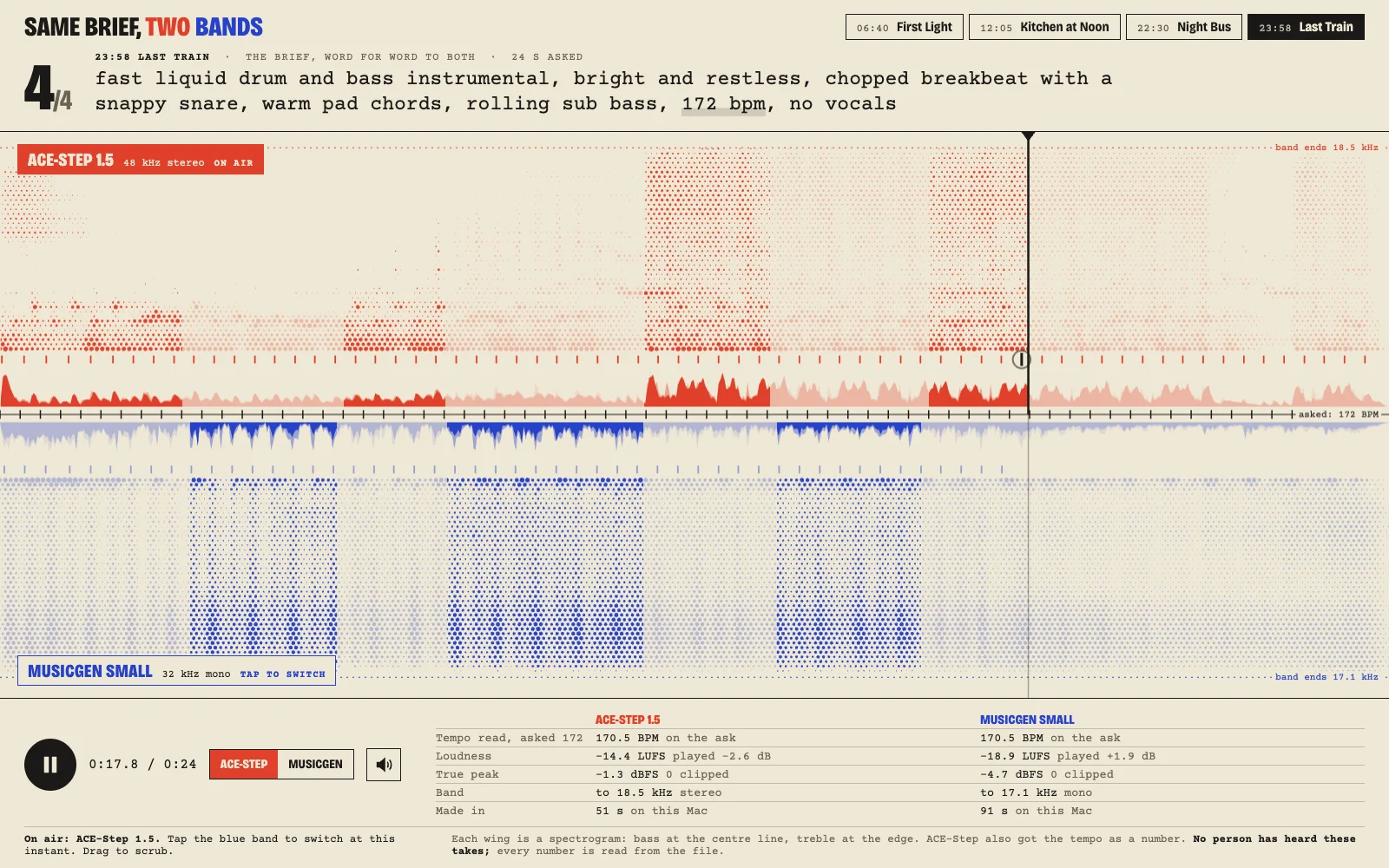
Still from Same Brief, Two Bands
21

Same Brief, Two Bands

local-modelsSound

Four written briefs, each played by two local music models, and one tap cuts from one band to the other at the same instant.

Try
Tap the sheet to play, tap the other band to switch
Made with
ACE-Step 1.5 (acestep-v15-turbo, 8 steps, planner LM acestep-5Hz-lm-1.7B on MLX 0.30.6; ace-step 1.5.0, seed 42) via local-models scripts/music_bed.sh with --bpm: 4 takes + 7 more
Open alone

Worked

  • Eight takes through the wrapper, one at a time, no guard refusal: each 24.00 s, 0 clipped samples, at most 0.07 s quiet at head or tail, all pass the skill's check.
  • Tempo read on the ask in 7 of 8 takes: MusicGen 4 of 4 from the words alone, ACE-Step 3 of 4 with --bpm (the tracker's grid is 1 to 3 % coarse).
  • Both takes of a brief start on one audio clock at one loudness (-17 LUFS by a gain per take), so a tap changes the band and nothing else.

Did not work

  • No person has heard any take: level, peak, clipping, silence, tempo, band and stereo are measured; whether a take sounds like its brief is not known.
  • First Light, ACE-Step: the check reads 87.9 BPM for 66 asked (or a 2:3 pulse) and still passes; the band ends at 5.3 kHz and one speaker loses 2.6 dB.
  • Last Train, MusicGen: beats stop at 17.3 s of 24 and the level falls 5.8 dB; loudness runs -14.4 to -18.9 LUFS though the wrapper aims at -16.

Made with

  • ACE-Step 1.5 (acestep-v15-turbo, 8 steps, planner LM acestep-5Hz-lm-1.7B on MLX 0.30.6; ace-step 1.5.0, seed 42) via local-models scripts/music_bed.sh with --bpm: 4 takes
  • MusicGen small (facebook/musicgen-small, transformers 4.57.6, torch 2.10.0, CPU, seed 42; weights CC-BY-NC-4.0) via local-models scripts/music_bed.sh: 4 takes
  • local-models scripts/music_check.py on every take (ffmpeg ebur128 and silencedetect, librosa 0.11.0 beat track)
  • ffmpeg 9.0.2 (the wrapper's master: 24 s kept of 39, fades, loudnorm, mp3 192 kbit/s)
  • src/analyze.py with numpy 2.3.5 and librosa 0.11.0 from the skill's own environment (envelopes, mel spectrograms, measures)
  • Web Audio API and canvas 2D in plain HTML, CSS and JS
  • puppeteer-core 23.10.4 + Chrome 157 and cwebp 1.6.0 (screenshots and the poster only)
  • Courier Prime and Bricolage Grotesque (@fontsource 5.1.1, OFL)
Still from One Tide
22

One Tide

local-modelsSound

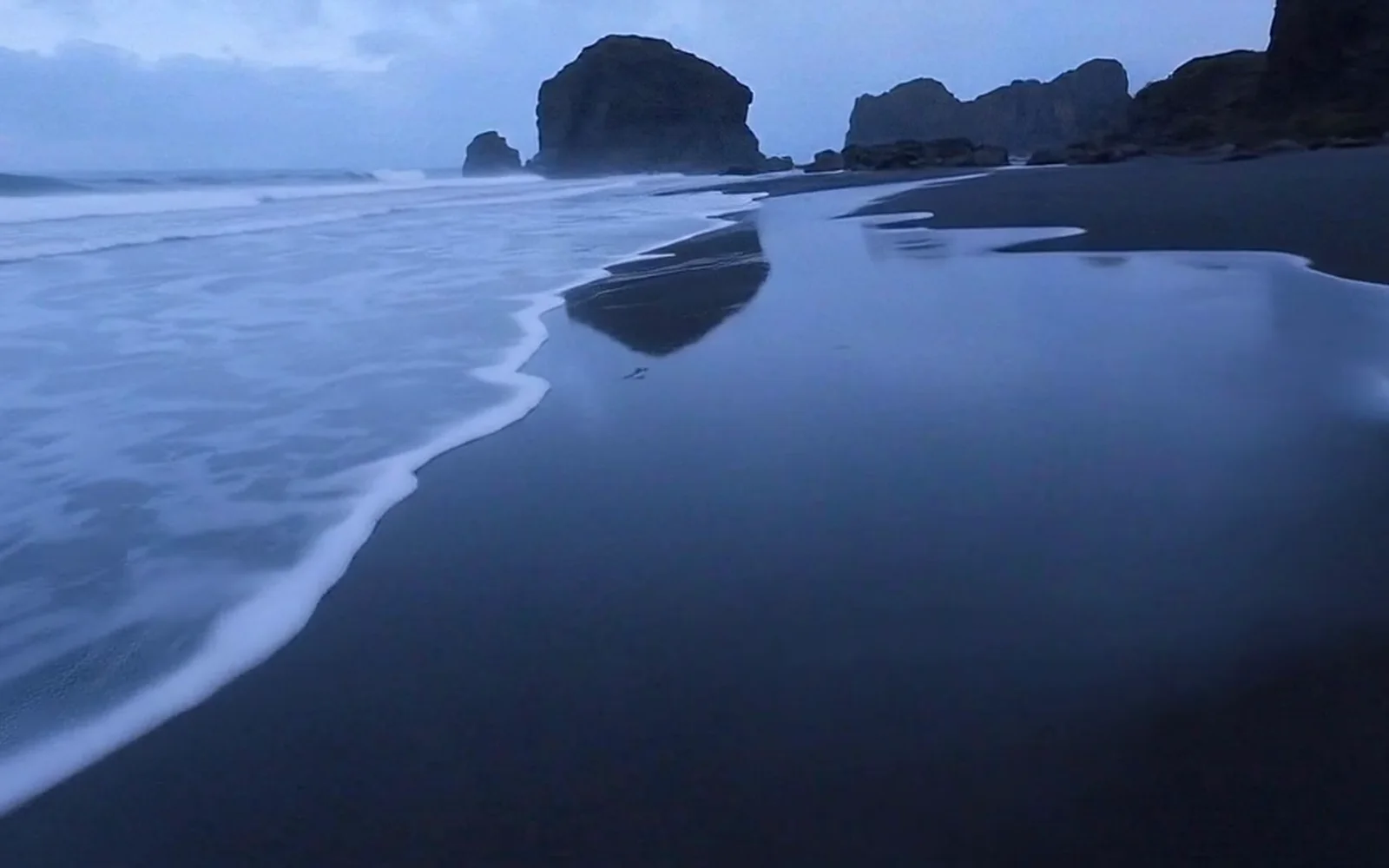
One unbroken 29-second glide over a black beach at dusk, chained from seven takes of a video model on this Mac, surf included.

Try
Press play, then drag along the tide line
Made with
LTX-2.3 distilled, MLX q4 (ltx-pipelines-mlx 0.18.0, mlx 0.32.2) via local-models scripts/video_ltx.sh and video_guard.sh + 6 more
Open alone

Worked

  • Seven takes chained with extend into one 29 s shot (697 frames, 1024 x 576); frames cut from the encoded film show no cut at the six seams.
  • 21 model runs of 51 to 255 s, one at a time through the guard (peak 15 to 17 GB); two lock refusals were waited out, none went around it.
  • RIFE doubled 697 frames to 1394 in 41 s; the player switches between 24 fps as made and 48 fps.

Did not work

  • No person has heard the surf: it is the model's own track, only measured (-17.1 LUFS, true peak -1.6 dBFS, 0 clipped, no gap inside).
  • Foam detail falls to 43 to 58 % of take 1 along the chain (22 to 32 % before the fixes), and a faint vertical band stands on the dark sand from 19 s.
  • A closing take anchored on the first frame did not loop (it flashed in its last ten frames), so the film ends on the second wave.

Made with

  • LTX-2.3 distilled, MLX q4 (ltx-pipelines-mlx 0.18.0, mlx 0.32.2) via local-models scripts/video_ltx.sh and video_guard.sh
  • ltx-2-mlx extend --distilled (six continuations, 25 pinned frames each)
  • RIFE v4.6 via local-models scripts/video_rife.sh (24 to 48 fps)
  • ffmpeg 9.0.2 (cut, sound levelling, ebur128, H.264 encode), cwebp
  • Python 3.14 stdlib
  • puppeteer-core 23.10.4 + Chrome 157 (screenshots only)
  • Fraunces and IBM Plex Mono (@fontsource, OFL)
Still from Drawn, then built
23

Drawn, then built

local-models

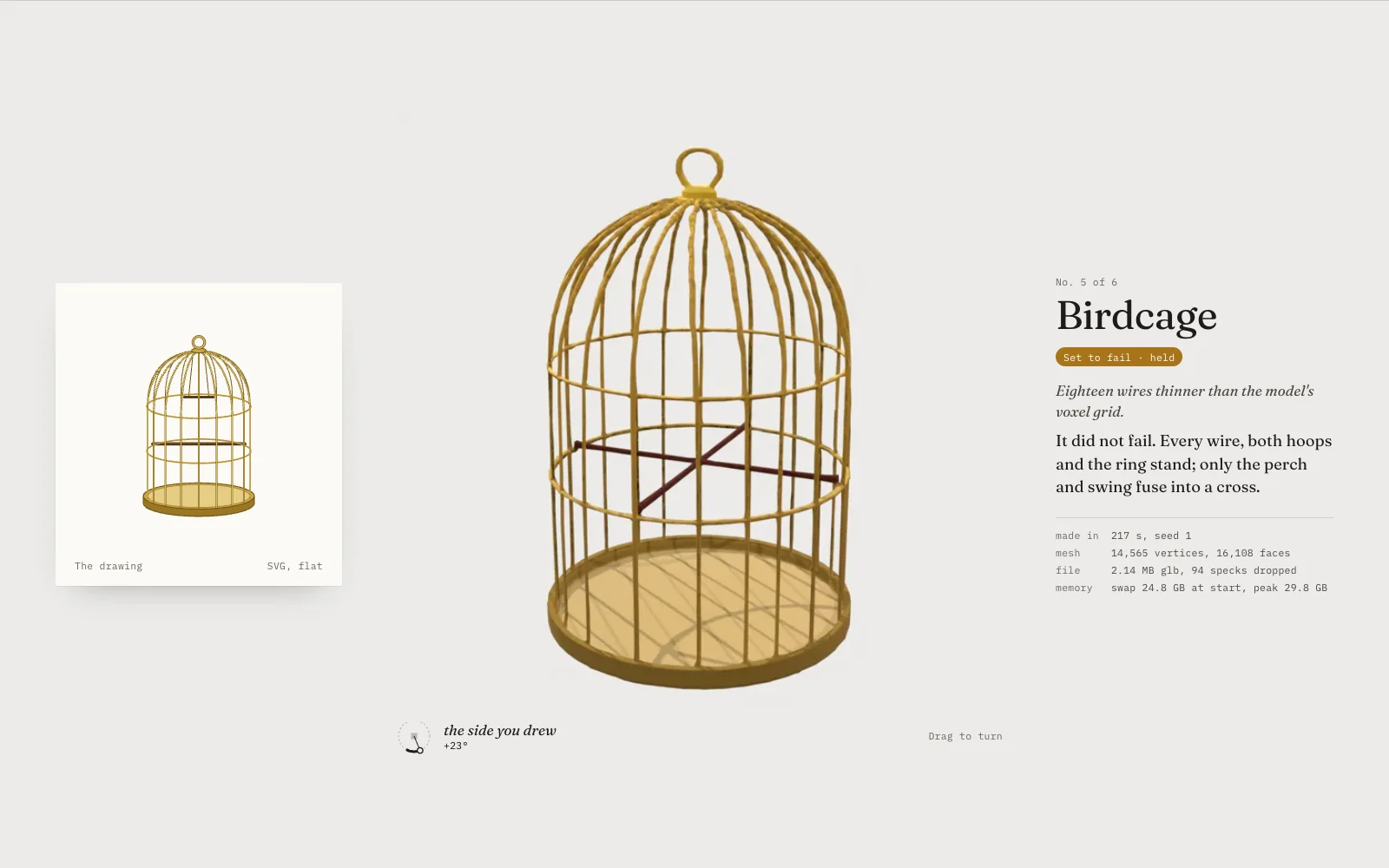
Six flat drawings made in code, each turned into an object by a model on this Mac; drag them round to find where the drawing ends.

Try
Drag an object to turn it
Made with
TRELLIS-image-large (MIT) via trellis-mac-mps f7c175a on MPS, torch 2.13.0, through local-models scripts/i23d_run.sh and i23d_fixuv.py + 4 more
Open alone

Worked

  • Six runs, one at a time through the guard: 164 to 373 s each, peak 30 to 50 GB with the lighter bake (the skill's proof: 517 s, 65 GB).
  • Teapot, chair, cactus and lighthouse come back closed from every side; the birdcage set to fail kept all eighteen wires.
  • Flat SVG with a transparent ground is enough input: the model takes the alpha as the object, holes and all.

Did not work

  • The impossible triangle becomes a real leaning A-frame that is a triangle only from the drawn side.
  • Backs drawn in shadow come out dark: the lighthouse's white stripes turn black on the side the drawing hid.
  • Spines, a flower and thin rungs thin out or stay paint; one seed per object, so seed spread is not measured.

Made with

  • TRELLIS-image-large (MIT) via trellis-mac-mps f7c175a on MPS, torch 2.13.0, through local-models scripts/i23d_run.sh and i23d_fixuv.py
  • local-models scripts/i23d_turntable.py in Blender 5.2.3 (EEVEE), 48 frames per object
  • trimesh 4.12.2 (speck clean-up), Pillow 12.2.0 (webp frames)
  • SVG written by Python 3.14, rasterised in Chrome 157 (headless, also screenshots)
  • Fraunces and IBM Plex Mono (OFL)
Still from Slack Water
03

Slack Water

blender-build

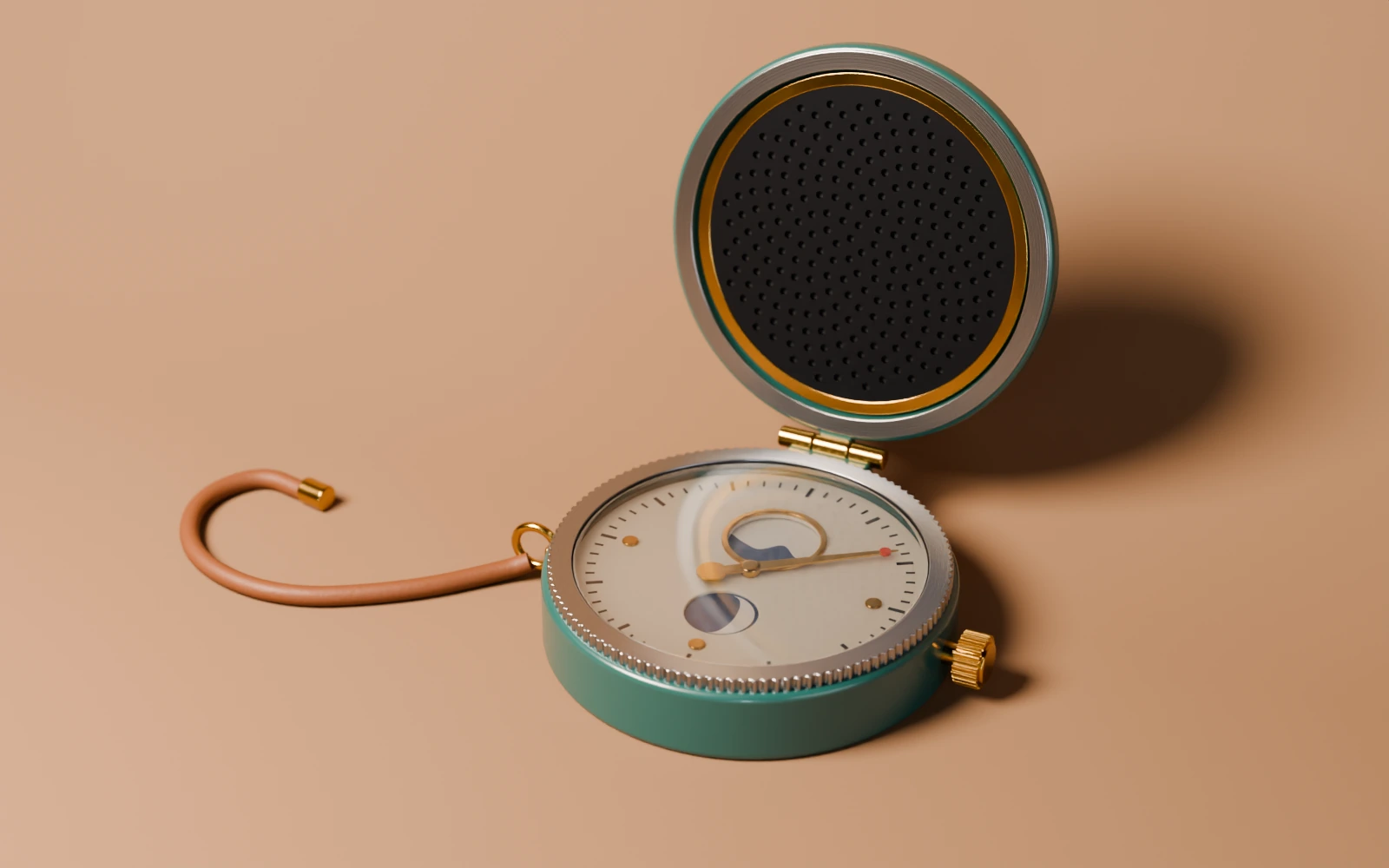
A pocket tide clock that does not exist, made of one Python file: turn it by hand, then watch the script assemble it part by part.

Try
Drag the clock to turn it
Made with
Blender 5.2.3, Cycles on Metal with OpenImageDenoise, AgX view (Workbench for blockout sheets) + 4 more
Open alone

Worked

  • 38 parts in 16 recorded steps from one script; the build film and its code panel come from the same file.
  • 48 Cycles turntable frames at 1200 px, 64 samples: 7 min, 8.7 s a frame.
  • Knurled bezel and crown from bmesh alone; a 233-hole golden-angle grille from eight math nodes in one geometry-nodes tree.

Did not work

  • The capacity guard held every render for three hours while simulators loaded the Mac.
  • The first turntable aimed off the pivot: the cord swung out of frame and needed a second 48-frame run.
  • The crystal throws a broad glare at the hero angle; it was raised, not solved.

Made with

  • Blender 5.2.3, Cycles on Metal with OpenImageDenoise, AgX view (Workbench for blockout sheets)
  • blender-build skill: scripts/build_template.py helpers, bmesh, geometry nodes (sunflower grille)
  • Python 3.14 + Pillow (WebP frames), plain HTML, CSS and JS
  • puppeteer-core 23.10.4 + Chrome (screenshots only)
  • Fraunces and IBM Plex Mono (OFL, vendored)
Still from Last Ferry
04

Last Ferry

blender-previz

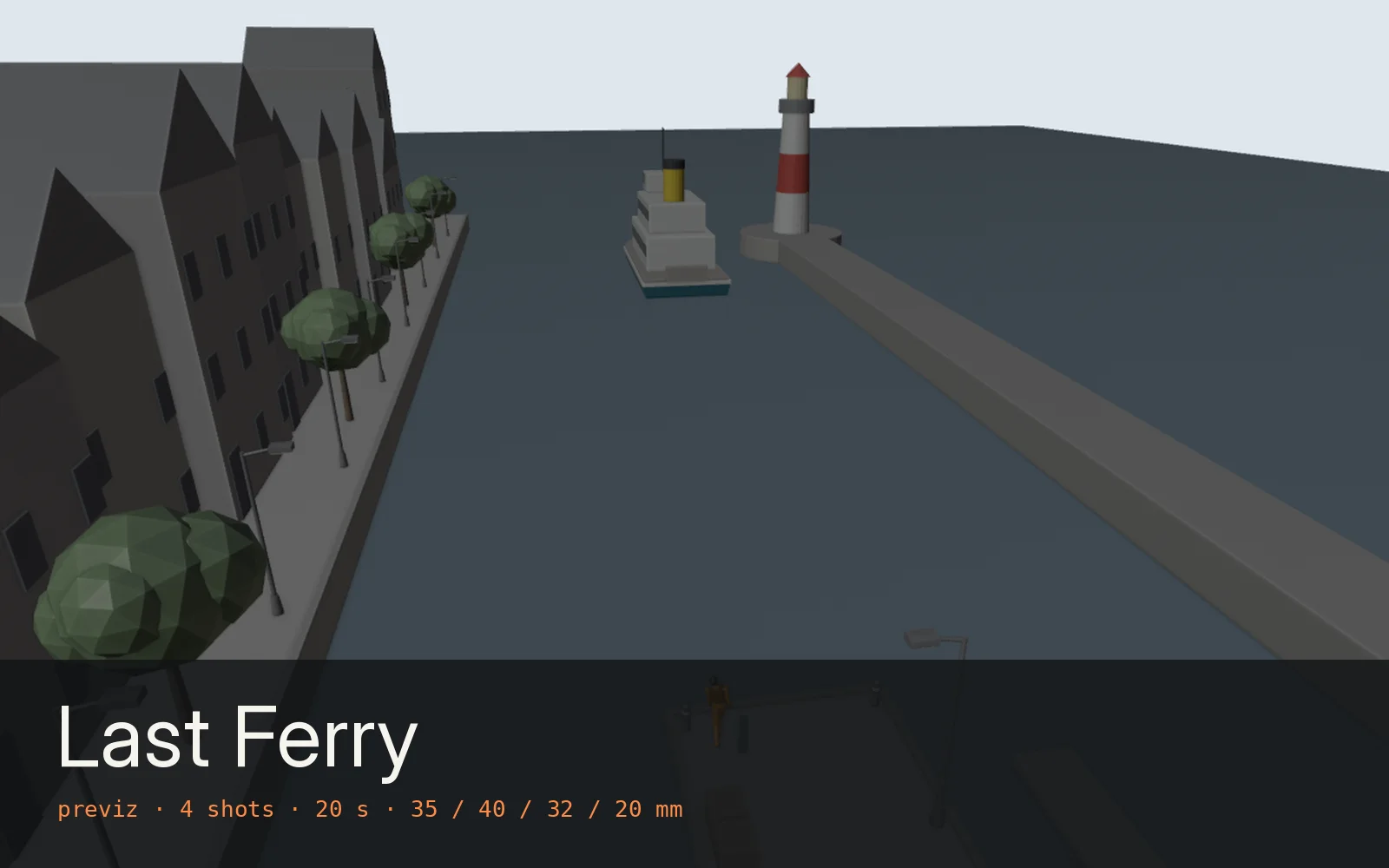
A 20-second grey-box previz: one walk down a pier, four camera moves, a plan from above that shows every camera live.

Try
Drag along the shot list; tap a camera path
Made with
Blender 5.2.3 LTS (Workbench, headless) + 5 more
Open alone

Worked

  • One master action cut by camera-bound markers: all four cuts land on their frames, 480 frames in 31 s.
  • Ground truth per frame drives the plan's live lens and the subject boxes on the film.
  • Mocap walk with feet planted to 0.6 cm slide; the subject stays in frame in all 480 frames.

Did not work

  • The first crane lost him for two thirds of the shot; fixed by aiming from his screen position.
  • The push-in to orbit cut was a jump cut at the same angle; the orbit now starts at his profile.
  • The CMU standing pose is crouched with the head tipped back; it reads tired, not still.

Made with

  • Blender 5.2.3 LTS (Workbench, headless)
  • blender-previz toolkit: mannequin.py, gait.py, props.py
  • CMU motion capture 35_01-03, 82_14, 07_01-02
  • numpy 2.5.4, Pillow 13.0.0
  • ffmpeg 9.0.2 (H.264 High, CRF 20)
  • Inter, DejaVu Sans Mono
Still from The Drawing Looks Back
24

The Drawing Looks Back

local-modelsSound

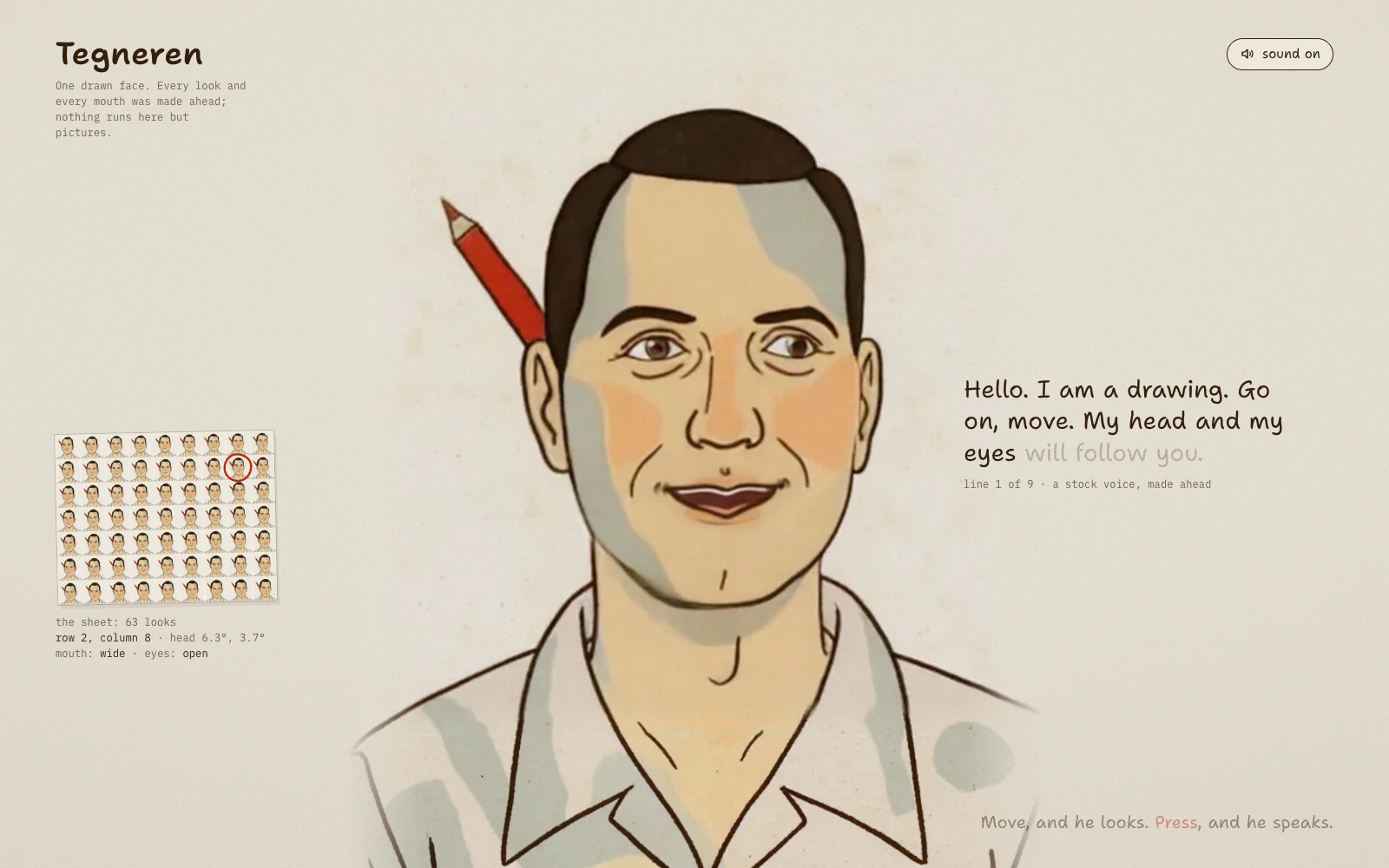
A drawn man turns his eyes and head to your pointer, blinks when left alone and speaks nine short lines with a drawn mouth when pressed.

Try
Move and he follows. Press and he speaks.
Made with
LivePortrait (commit 9b294b3, 2 June 2026) via local-models scripts/video_liveportrait_looks.sh inside video_guard.sh: 9 grids of 9 x 7 looks, 567 stills + 8 more
Open alone

Worked

  • One looks grid per mouth shape: the drawn mouth turns with the head, so he speaks while he follows; 63 looks, 7 open mouths and a blink in 2.2 MB of pictures.
  • Mouth timed with no lip-sync model: 296 cues on one 37.6 s track; shut in 98.6 % of quiet frames, open in 88.5 % of loud ones, best fit at 0 ms lag in every take.
  • Nine Kokoro takes joined into one track: whisper heard 102 of 104 words the same (the other two are 'sixty-three' written '63'); -17.2 LUFS, true peak -2.3 dBFS, 0 clipped samples.

Did not work

  • No person has heard any take or watched the lips against the sound: loudness, peak, silence, words and mouth timing are measured, not listened to.
  • LivePortrait renders 512 px across the face: ink lines are soft at full screen, the blink is a grey smear and the jaw blurs in the outer column.
  • The head turns only 10 degrees to the sides and 7 up and down; the earlier looks tests lost the ear's ink line beyond that, so the turn stays small on a wide screen.

Made with

  • LivePortrait (commit 9b294b3, 2 June 2026) via local-models scripts/video_liveportrait_looks.sh inside video_guard.sh: 9 grids of 9 x 7 looks, 567 stills
  • Drawn mouths: seven open shapes and the shut one, made in code from the drawing's own ink (taken from out/face, the skill's drawn-mouth route), pasted into the master still by src/make_sources.py
  • Voice Studio 0.5.8 on 127.0.0.1:3900 via local-models scripts/vs_narrate.sh and vs_check.py
  • Kokoro-82M bf16 via mlx-audio, stock voice bm_george (English, nobody cloned)
  • whisper.cpp 1.9.5, large-v3-turbo q8_0 (word order for the mouth cues; every take transcribed back)
  • ffmpeg 9.0.2 (the nine takes joined into one mp3 track; ebur128 loudness and true peak)
  • Python with OpenCV 4.11.0, Pillow 12.3.0, numpy 1.26.4 (cut-out sheets, mouth timing, measures)
  • puppeteer-core 23.10.4 + Chrome 157 (screenshots and the poster only)
  • Shantell Sans and IBM Plex Mono (@fontsource 5.1.1, OFL)
Still from The Tide, Answered
25

The Tide, Answered

higgsfield-cliSound

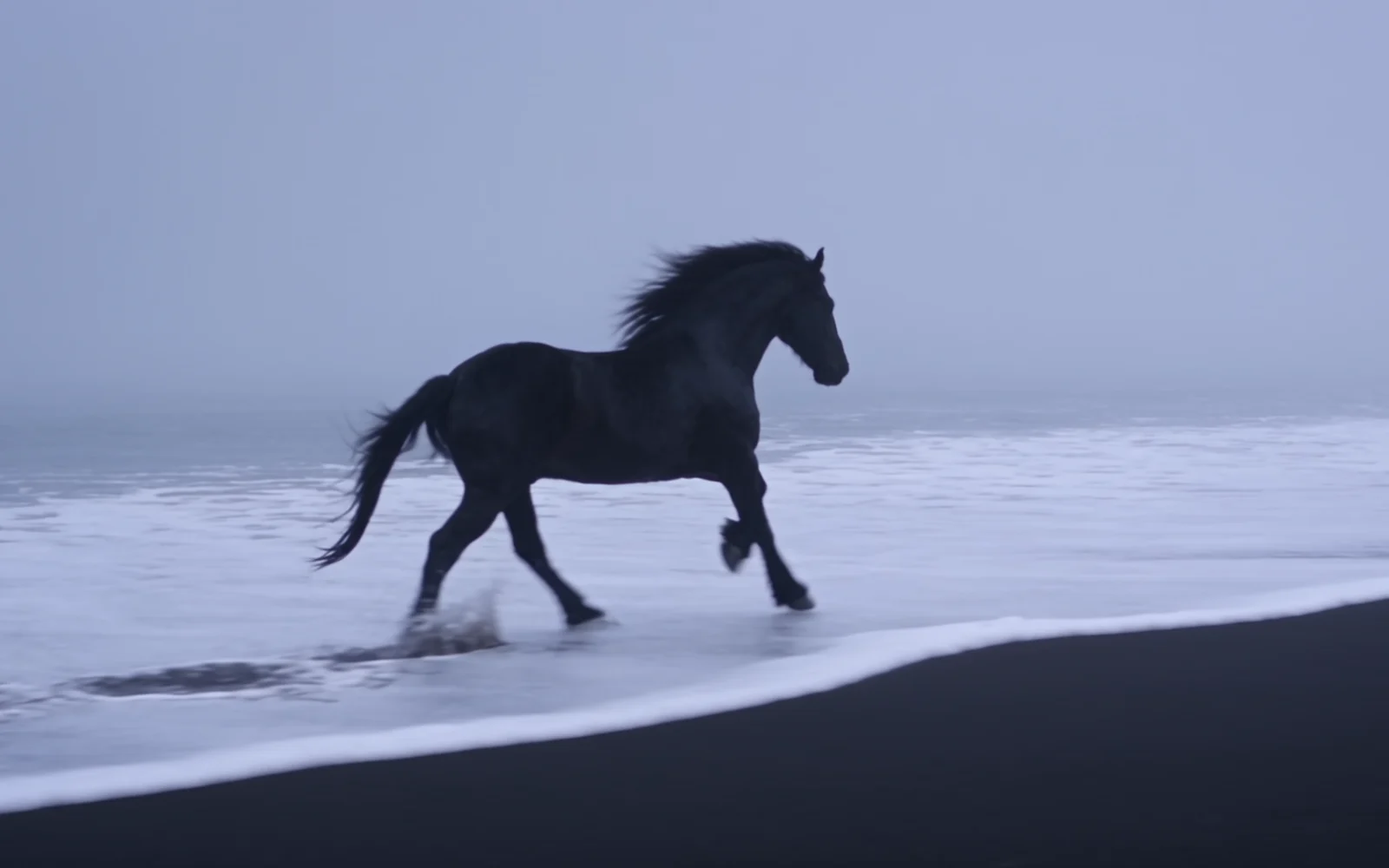
A paid model takes a local film's last frame and lets a horse gallop out of it, then meets the local model on the same words.

Try
Play, then switch to Same words
Made with
Higgsfield CLI 1.2.2, Seedance 2.5 (seedance_2_5): t2v 5 s 720p, omni_reference 10 s 1080p draft then final on the draft + 6 more
Open alone

Worked

  • Starts from s22's last frame: the 4 s hand-over is close, not identical (13 % less saturated, eased to 3 % here); one job gave three shots of one horse at 1080p.
  • Draft 30 credits, final 160 on the same draft: cuts landed on the same frames (4.21 s and 6.08 s into the clip, 8.2 s and 10.1 s on the bar); total spend 225 credits, about USD 17.78.
  • A body in motion the local model cannot hold; edge detail 17.9 against 6.7 for s22's last 10 s, but not like for like (another scene, made at 1080p).

Did not work

  • Same prompt: the paid take barely pushes (motion 1.8 against 7.3) and has less foam texture (10.6 against 14.5).
  • It copied s22's faint vertical band into its first shot; the hooves close-up lasts only 1.9 s.
  • No person has heard either sound; measured only (paid as made -28.5 to -31.9 LUFS, levelled here).

Made with

  • Higgsfield CLI 1.2.2, Seedance 2.5 (seedance_2_5): t2v 5 s 720p, omni_reference 10 s 1080p draft then final on the draft
  • Higgsfield Terms of Use, updated 23 Oct 2026 (read 18 Nov 2026), s. 4.4: no ownership claim on inputs or outputs, commercial use of outputs not restricted; inputs and outputs may train its models unless under an Enterprise Agreement; outputs not guaranteed unique or exclusive
  • s22 film (LTX-2.3 distilled, MLX q4, on this Mac), read-only
  • ffmpeg 9.0.2 (cut, loudnorm, ebur128, H.264 encode), cwebp 1.6.0
  • Python 3.15.2 stdlib
  • puppeteer-core 23.10.4 + Chrome (screenshots only), Node 26
  • Fraunces and IBM Plex Mono (@fontsource, OFL)

Combined

Two or more skills in one piece, to see what the join gives and where it breaks.

Still from A Curve That Comes Home
C03

A Curve That Comes Home

manim-video + local-models + motion-labSound

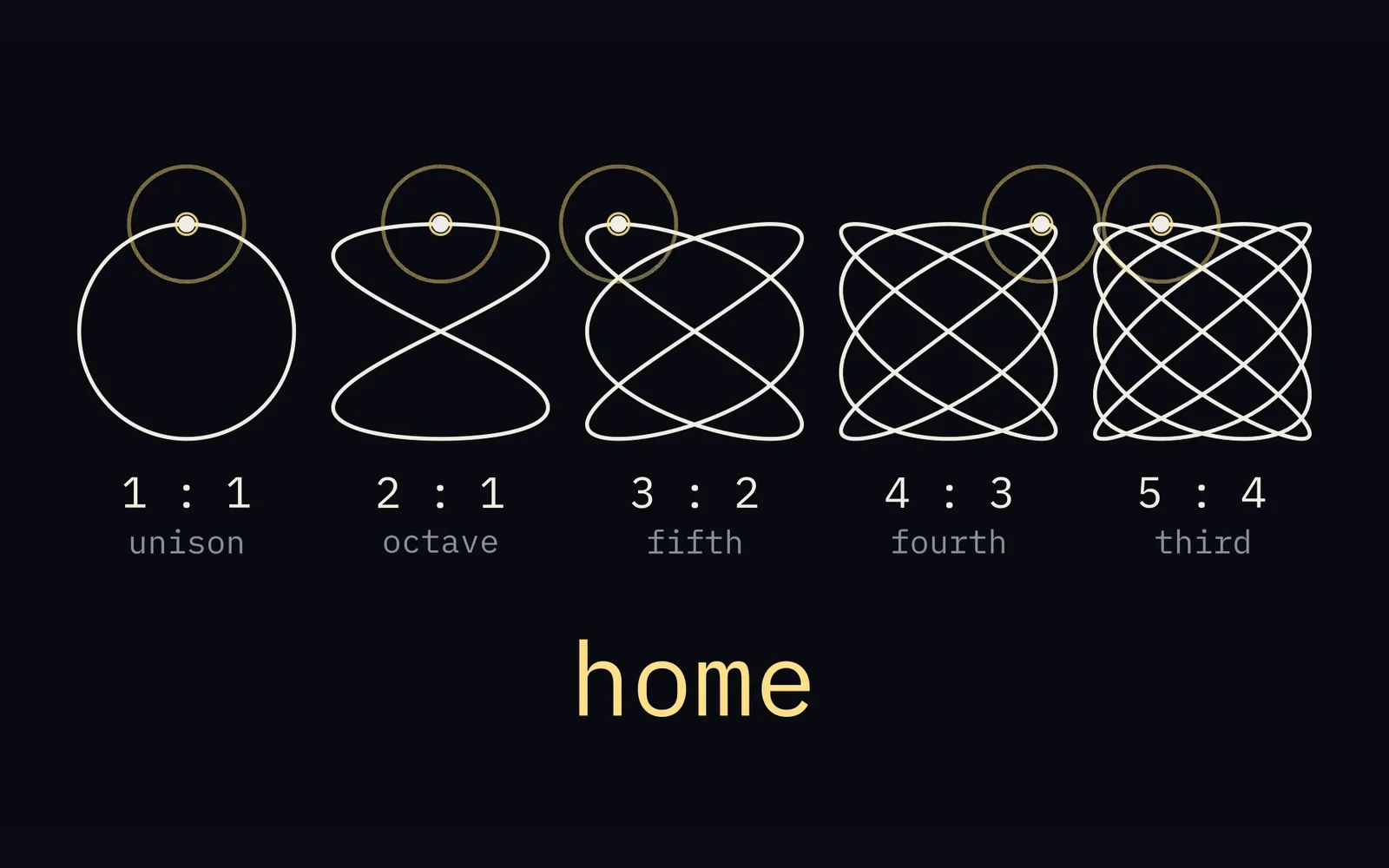
A narrated minute on why two notes agree: each curve is drawn by the two notes you hear and closes on the word that names it.

Try
Press the ring; drag the line to scrub
Made with
manim-video: Manim CE 0.22.1 (Python 3.12, numpy 2.5.5), every frame posed from its frame number, 1080p30 in four parts + 5 more
Open alone

Worked

  • One timeline, cut from the voice take at its own pauses, drives picture, score and player: all 25 marks change on their frame in the encoded film.
  • The score is the subject: the two notes heard are the two ratios drawn (220 Hz times a/b), and a bell lands where each curve comes home.
  • Every frame is a function of its number, so a fault found on encoded frames cost one part of 11 to 17 seconds, not the film.

Did not work

  • whisper word times sat a median 520 ms before the take's real onsets; the script was rewritten twice so each naming phrase follows a pause.
  • No person has heard it: loudness (-16.0 LUFS, peak -2.2 dBFS), silence and the words (103 of 103) are measured, the taste of the mix is not.
  • The two chords that land on a spoken 'home' are masked by the voice, so their frame is not proven; the first render waited 14 minutes on a shared lock.

Made with

  • manim-video: Manim CE 0.22.1 (Python 3.12, numpy 2.5.5), every frame posed from its frame number, 1080p30 in four parts
  • local-models voice: Kokoro-82M (mlx-audio, voice bm_george, seed 7) through vs_narrate.sh on Voice Studio 0.5.8
  • whisper.cpp large-v3-turbo q8 (vs_check.py) as the only ear: the take, each cut piece and the finished film
  • motion-lab sound: a coded score on sfx.mjs parts (Node 26.0.0), no samples, mixed with the voice to -16 LUFS
  • ffmpeg 9.0.2 (H.264 CRF 19, AAC 160k), cwebp 1.6.0, IBM Plex Mono 400 and 500 (OFL, in vendor/)
  • Google Chrome 157 (player checks at 1440 x 900 and 390 x 844)
Still from Plan to Part
C08

Plan to Part

architecture-diagram + technical-figures + motion-labSound

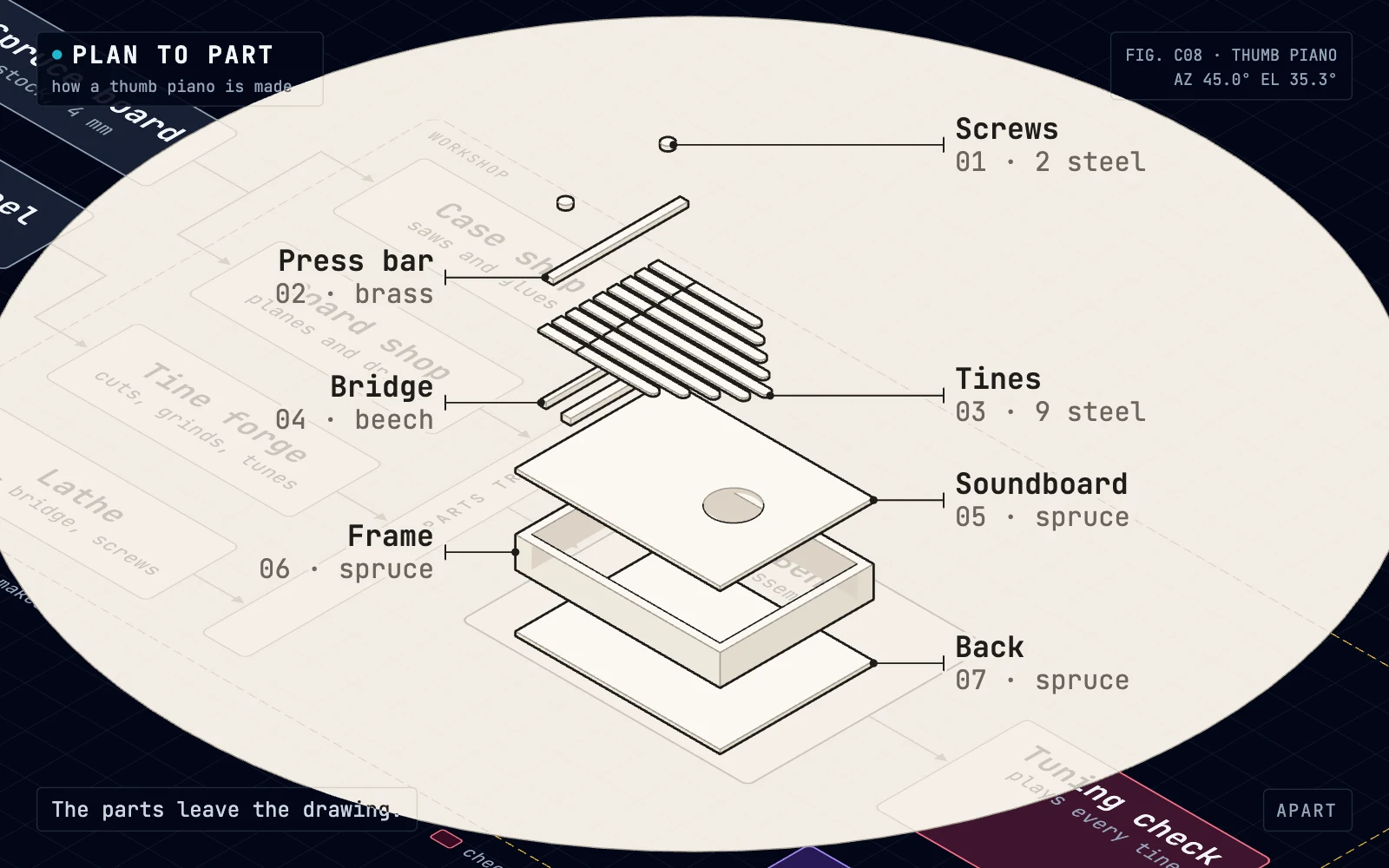
A workshop's system diagram tilts 54.7 degrees into the floor of an exploded thumb piano, which closes up and plays the score.

Try
Press the box; drag the route to scrub
Made with
architecture-diagram design system (seven typed colours, double-rect boxes, arrows under boxes, a bus in the gap, JetBrains Mono variable, vendored) + 4 more
Open alone

Worked

  • One orthographic camera carries both drawings: the diagram is the z = 0 plane of the figure's space, so the hand-over is a 54.7 degree tilt, not a cross-fade.
  • One timeline file gives picture, score and player their frames and pitches: each tine dips on the frame of its note, and the 44 clear hits measure 40 to 46 ms after their frame (target 41.7).
  • The paper is a round sheet lying on the plan: outside it the diagram keeps its seven colours on dark, inside it is redrawn in the figure's inks, so the palettes meet at one edge.

Did not work

  • Diagram lines and names sit inside the camera matrix and grew with the push-in (a 6 px bench outline against a 3 px silhouette); seen only on encoded frames, fixed in round 2.
  • A left-to-right route fills 90% of a 16:9 frame's width and under 60% of its height, so the plan shots carry dark bands above and below.
  • Under the paper the diagram loses its colour types (the figure allows one accent), so there a box is told by its words only.

Made with

  • architecture-diagram design system (seven typed colours, double-rect boxes, arrows under boxes, a bus in the gap, JetBrains Mono variable, vendored)
  • technical-figures drawing rules and the prism-engine.js method (true isometric, three line weights, one accent, leaders), rewritten against a shared camera
  • motion-lab render.mjs (Playwright 1.64.1, headless Chromium, 1 to 12 subframes by range), sfx.mjs functions for the coded score (120 BPM, -14 LUFS), measure.py
  • SVG rebuilt for every frame by one function of time; Node 26.0.0, ffmpeg 9.0.2 (H.264 High CRF 18, AAC 192k), cwebp 1.6.0
  • No person has heard the score: it is checked by loudness, peak, silence and onset measures only
Still from A design system that moves
C06

A design system that moves

popular-web-designs + design-md + design-to-motion

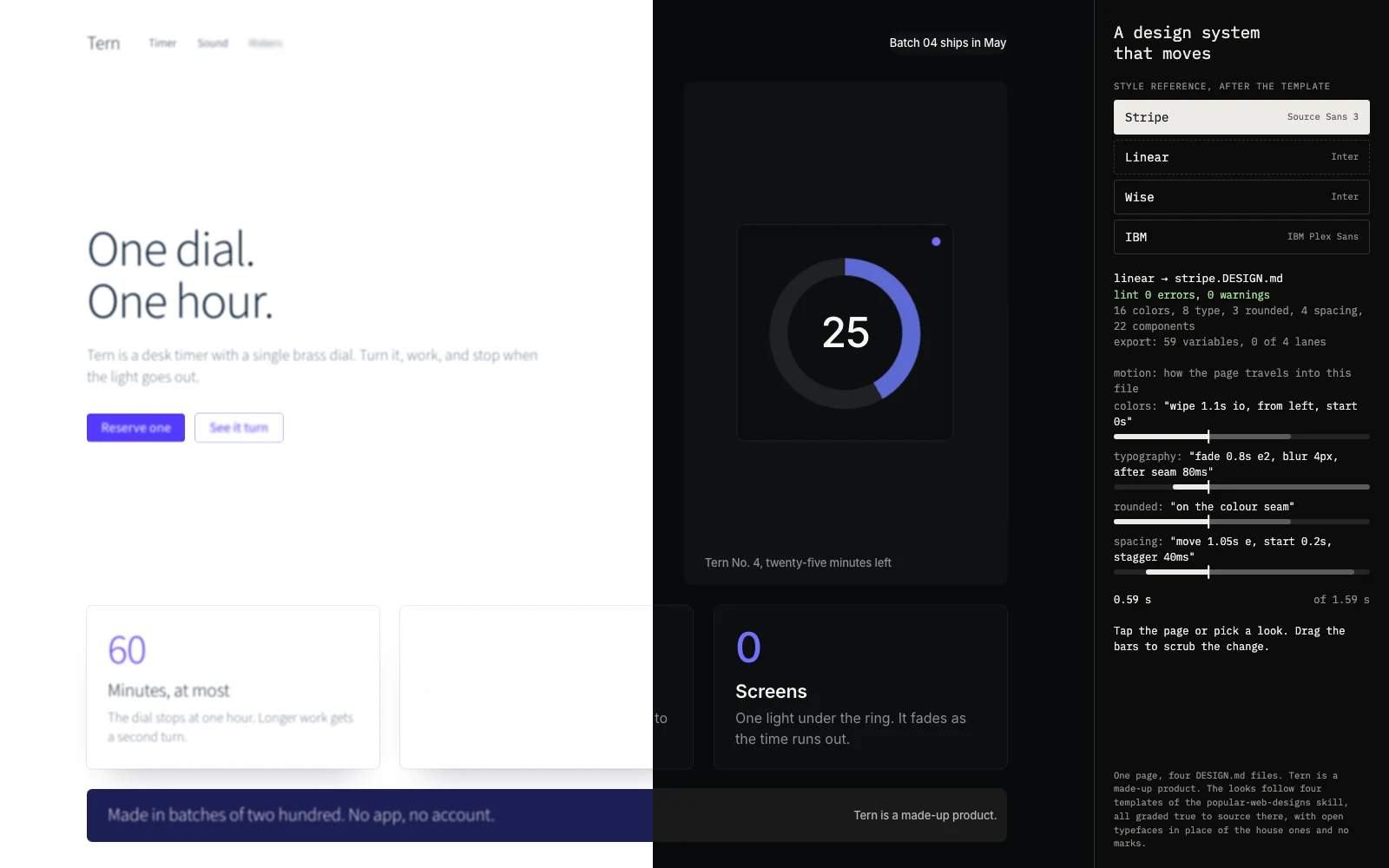
One product page travels between four DESIGN.md files; each file says how colour, type, corners and spacing move into it.

Try
Tap the page or pick a look. Drag the bars.
Made with
@google/design.md 0.4.0 (linter bundled into the page with esbuild 0.28.2) + 5 more
Open alone

Worked

  • Four files lint clean in the page with the real linter; the page holds no colour, face, size, corner or gap of its own.
  • 12 travels at two sizes start on the exact still and land on it; only transform, opacity, filter and clip-path move.
  • One generator turns a template's token extract into a DESIGN.md with its motion lanes.

Did not work

  • The format cannot see motion: no lint finding for the section, no export carries it, diff reports no change.
  • Type cannot morph under the four-property rule; behind the seam the new copy is soft for a third of a second.
  • Lede, button, numeral and phone type had to be read from each template's tables by hand.

Made with

  • @google/design.md 0.4.0 (linter bundled into the page with esbuild 0.28.2)
  • popular-web-designs templates stripe.md, linear.app.md, wise.md, ibm.md
  • Web Animations API, plain HTML, CSS and JS
  • Inter 5.3.0, Source Sans 3 5.3.1, IBM Plex Sans 5.3.0, IBM Plex Mono 5.3.0 (fontsource, OFL-1.1)
  • playwright-core 1.65.1 with the cached Chromium headless shell 1254
  • ffmpeg 9.0.2 (PSNR), cwebp 1.6.0, Node 26.0.0, Python 3
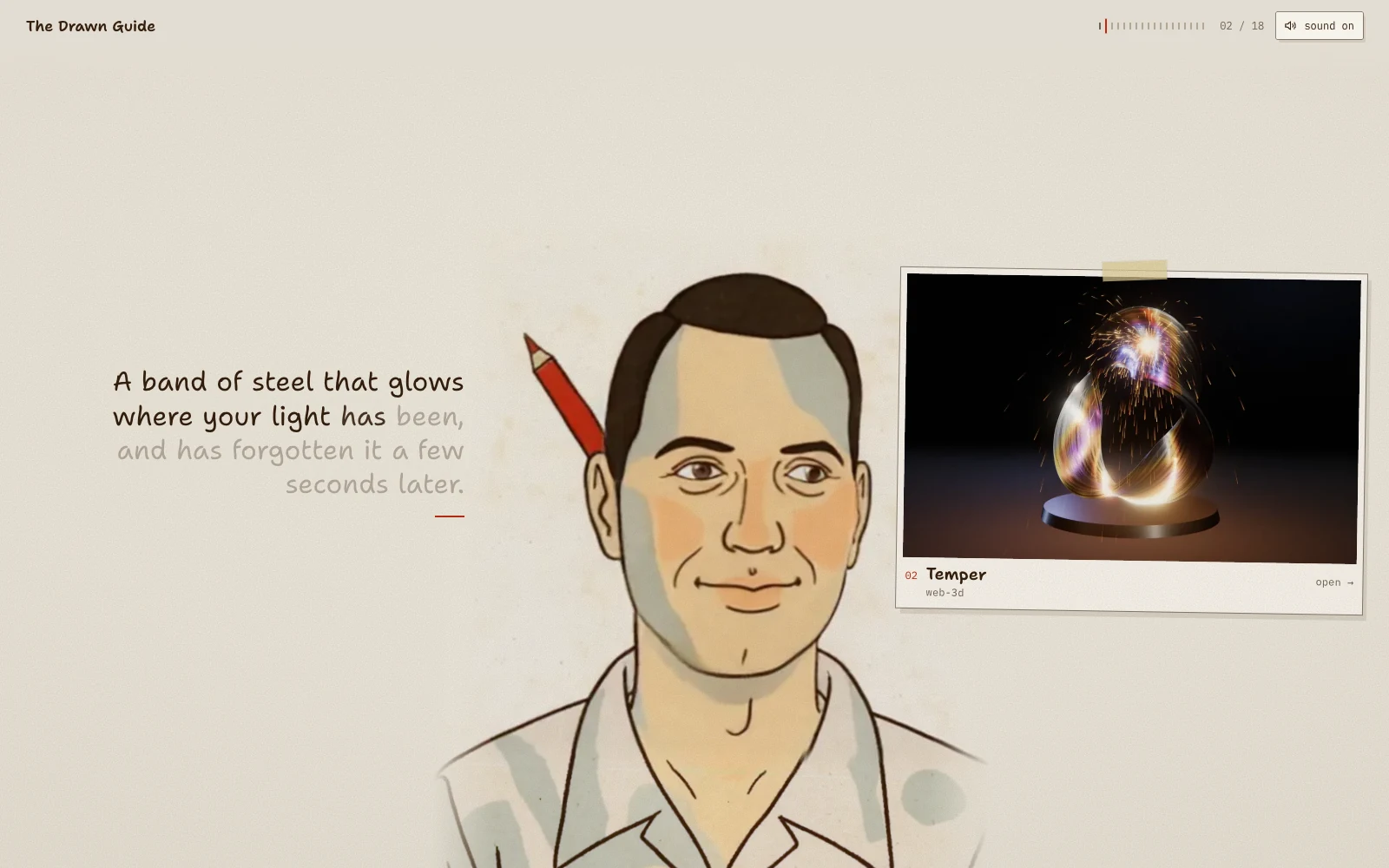
Still from The Drawn Guide
C07

The Drawn Guide

local-models + interactive-webSound

A drawn man walks you past twenty-five pieces, turns to each poster and says one true sentence about it, faults included.

Try
Scroll. Press once and he says each line aloud.
Made with
The picture sheets and face.json of s24-local-face, reused unchanged: LivePortrait (commit 9b294b3) looks in a 9 x 7 grid, the drawn mouths in eight shapes; no picture model was run for this piece + 8 more
Open alone

Worked

  • The same face took a new job with no model run: s24's sheets unchanged; he turns to each poster, leans, and turns back to you for the second half of the line.
  • 20 Kokoro takes, one file a stop (1,058 KB): whisper gave each line back, bar digits for numbers and one "choral" for "coral"; mouth shut in 100 % of quiet frames, open in 92.6 % of loud.
  • The weight follows the visitor: 889 KB at first load, mouths and takes after the first move, posters and takes two stops ahead; 4.2 MB after all 18.

Did not work

  • No person has heard a take or used the page on a real phone: the wake-up of the sound after a phone pause ran only in headless Chrome.
  • The head turns 10 degrees at most, so at every stop the look sits at the edge of its grid: he reads as turned left or right, not as following the poster.
  • A stop opens its piece inside the guide's own frame (../<id>/): the contract forbids the top-window link the card asked for, and the shell is not told.

Made with

  • The picture sheets and face.json of s24-local-face, reused unchanged: LivePortrait (commit 9b294b3) looks in a 9 x 7 grid, the drawn mouths in eight shapes; no picture model was run for this piece
  • Voice Studio 0.5.8 on 127.0.0.1:3900 via local-models scripts/vs_narrate.sh and vs_check.py, run inside video_guard.sh
  • Kokoro-82M bf16 via mlx-audio, stock voice bm_george (English, nobody cloned): 27 takes
  • whisper.cpp 1.9.5, large-v3-turbo q8_0 (word order for the mouth cues; every take transcribed back)
  • ffmpeg 9.0.2 (one mono mp3 per stop at 64 kb/s; ebur128 loudness and true peak)
  • Python 3.14.9 with numpy 2.5.5 (mouth timing and measures, s24's method) and Pillow 11.3.0 (posters at 960 x 600)
  • interactive-web: one requestAnimationFrame clock, the scroll as the clock, canvas 2D and Web Audio; no library
  • puppeteer-core 23.10.4 + Chrome 157 (screenshots and the poster only)
  • Shantell Sans and IBM Plex Mono (@fontsource 5.1.1, OFL)
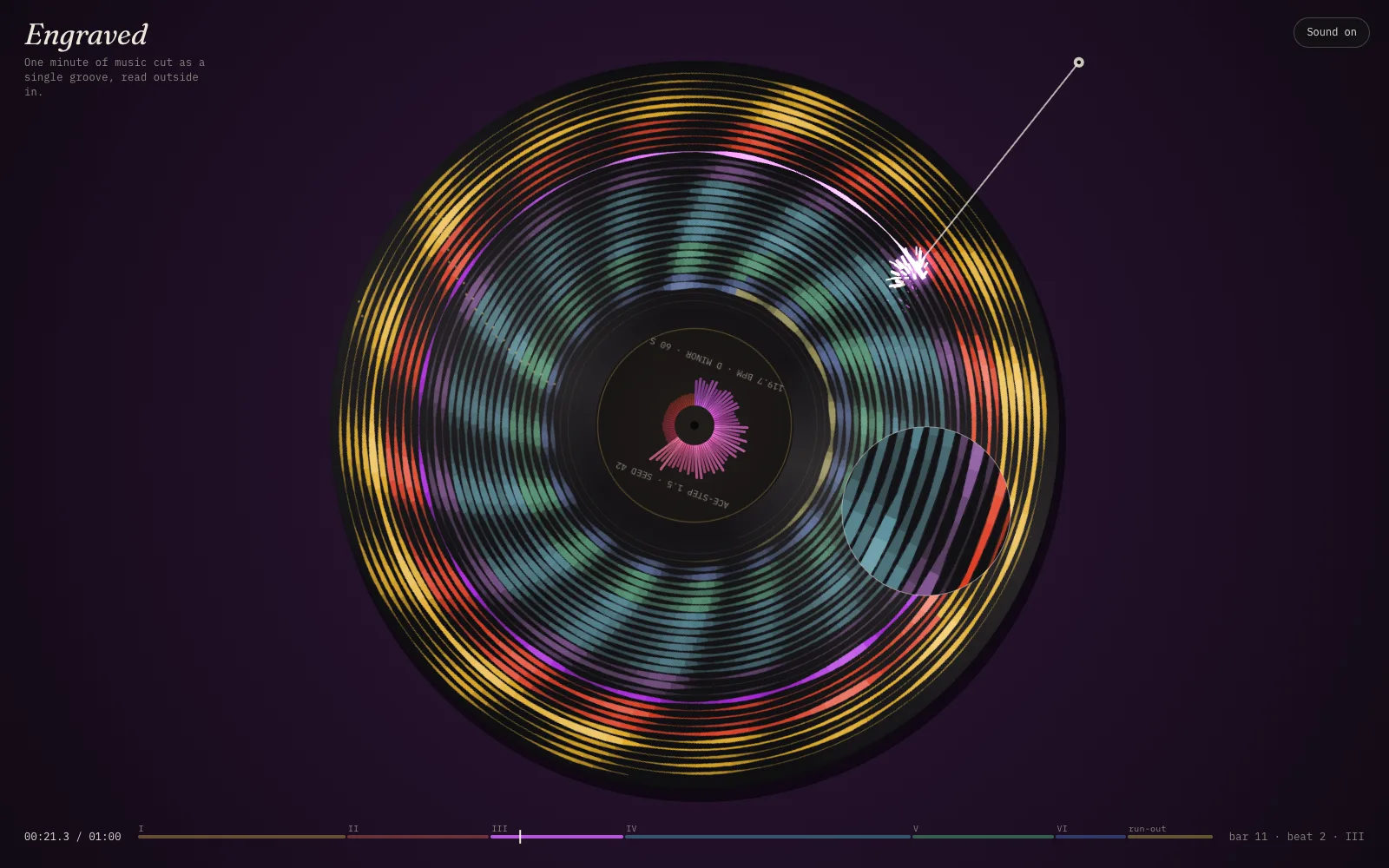
Still from Engraved
C11

Engraved

local-models + p5js + interactive-webSound

One minute of music made on this Mac, cut as one spiral groove; your finger moves the light, never the time.

Try
Tap to play; move the light, hold for the lens
Made with
ACE-Step 1.5 (turbo, planner LM, seed 42, --bpm 120, D minor) via local-models scripts/music_bed.sh, one model at a time under ~/models/model.lock, nice -n 10 + 6 more
Open alone

Worked

  • Live analyser low band vs precomputed score at the audio clock: r 0.96 desk, 0.97 phone, best lag 0 ms (headless).
  • Pointer and touch steer light, sparks and lens only: 2.378 s of clock across 2.374 s of wall while dragging.
  • --bpm 120 gave 119.7 BPM with beat CV 0.009, so one bar per turn draws four straight beat spokes up to the run-out.

Did not work

  • No person has heard or watched it; sync is measured in headless Chromium only, Bluetooth latency and Safari untested.
  • First look blew the lit groove out to flat rings; amplitude needed a shaping curve before the beats showed.
  • Sections are an agglomerative guess: section IV (27-43 s) may be two parts to the ear.

Made with

  • ACE-Step 1.5 (turbo, planner LM, seed 42, --bpm 120, D minor) via local-models scripts/music_bed.sh, one model at a time under ~/models/model.lock, nice -n 10
  • local-models scripts/music_check.py (60.0 s, -16.5 LUFS, -2.9 dBTP; passes all but beats-to-end: a 4.8 s run-out)
  • src/analyze.py with librosa 0.11.0 + numpy (groove lanes, bands, onsets, beats, sections to score.json)
  • p5.js 1.11.3 (instance mode, createGraphics bake + incremental lit buffer, canvas 2D)
  • Web Audio API (getOutputTimestamp clock, AnalyserNode live layer)
  • Playwright + Chromium headless (stills, sync correlation, pause and scrub checks)
  • Fraunces and IBM Plex Mono (OFL)
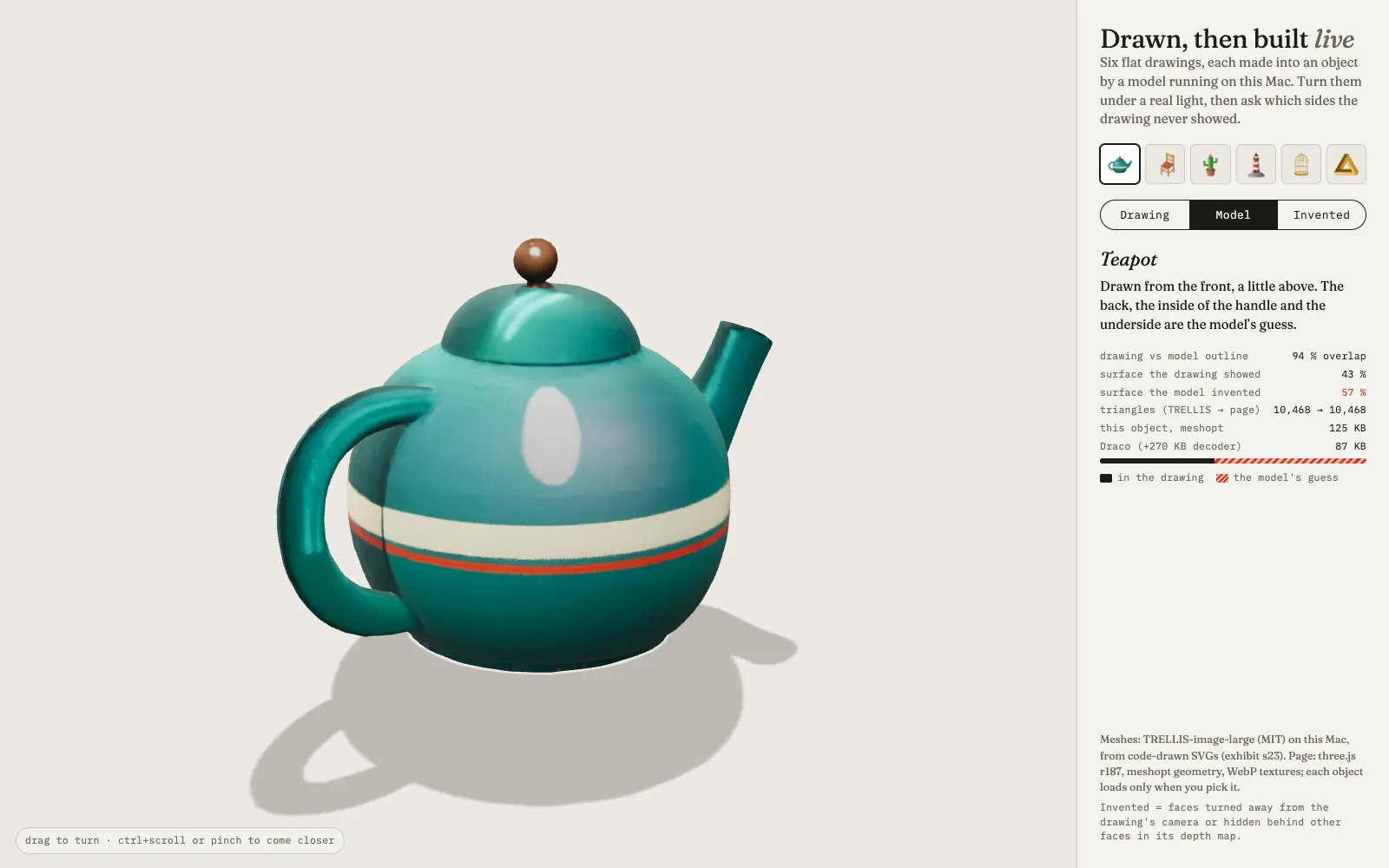
Still from Drawn, then built: live
C09

Drawn, then built: live

local-models + web-3d

The six objects a model on this Mac built from flat drawings, live under a real light, with every side the drawing never showed in red.

Try
Drag to turn; try Invented
Made with
Meshes from exhibit s23: TRELLIS-image-large (MIT) on MPS via local-models; no new model run + 4 more
Open alone

Worked

  • A flat drawing lines up with its mesh to 56-96 % (86-96 % on five of six) outline overlap once the drawing's own camera is searched for (yaw and pitch, not an axis).
  • Invented mode is a shader with a depth map from that camera: 57-61 % of each surface is the model's guess, 75 % on the impossible triangle.
  • Meshopt plus WebP cuts each object from 1.4-2.1 MB to 125-263 KB; only the one you pick loads.

Did not work

  • The TRELLIS export says metallic 1 and ships no normals: it needed metallic 0 and seam-welded normals before it looked like paint under PBR.
  • The impossible triangle matches its drawing only from 106 degrees round: TRELLIS put the drawn view on the side, not the front.
  • Draco files are 25-35 % smaller, but its 270 KB decoder pays off only after one or two objects are opened.

Made with

  • Meshes from exhibit s23: TRELLIS-image-large (MIT) on MPS via local-models; no new model run
  • three.js r187 (MIT), vendored by web-3d scripts/vendor_three.mjs: GLTFLoader, OrbitControls, meshopt decoder, RoomEnvironment
  • gltf-transform 4.5.1 and meshoptimizer: 12k-triangle budget, WebP textures, EXT_meshopt_compression (Draco measured, not shipped)
  • Drawing camera fitted by silhouette and colour in headless Chrome 157 (src/fit.html), seen share by depth test (src/manifest.mjs)
  • Fraunces and IBM Plex Mono (OFL)
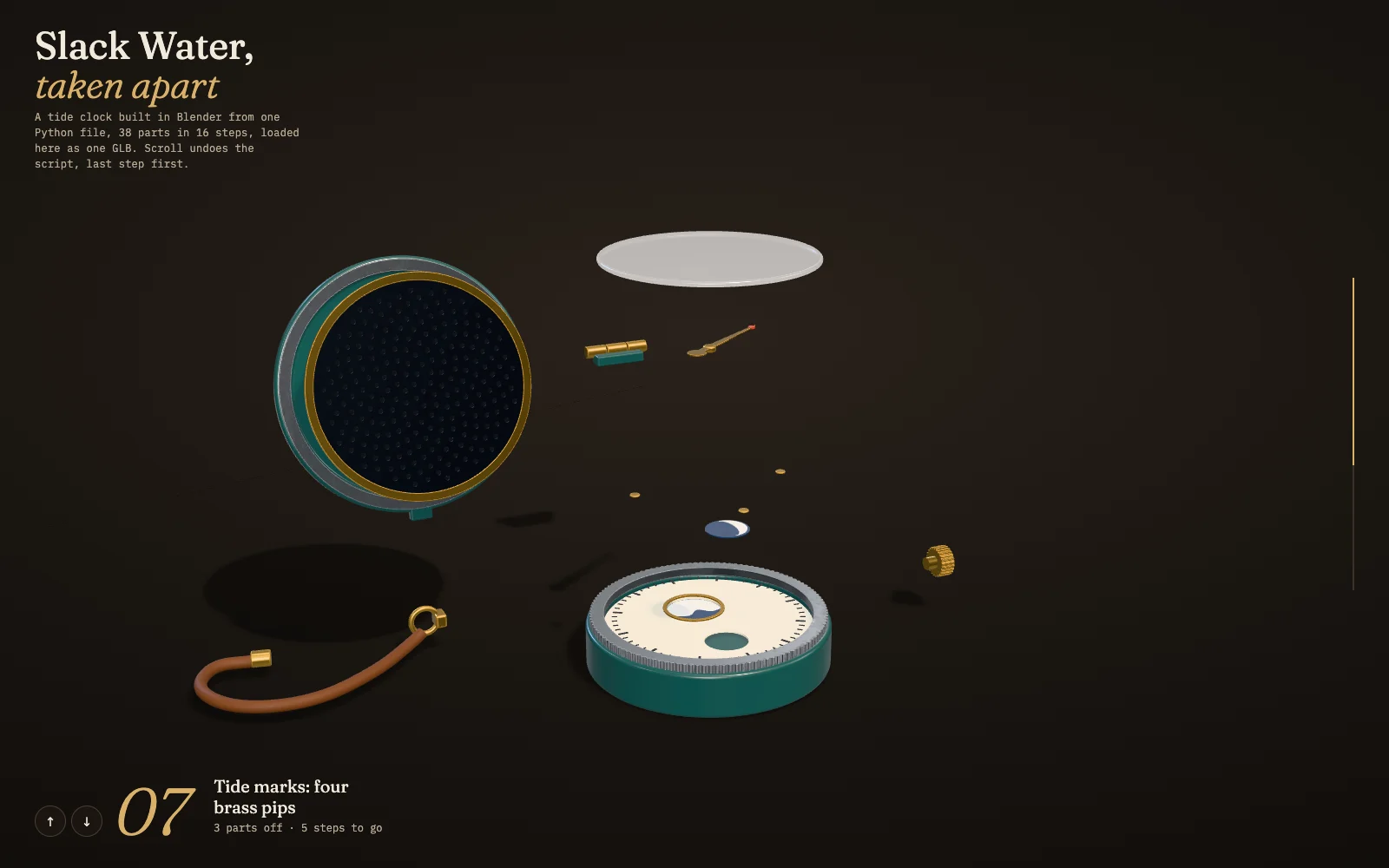
Still from Slack Water, taken apart
C10

Slack Water, taken apart

blender-build + web-3d + interactive-web

A tide clock built in Blender from one Python file comes apart part by part as you scroll; tap any of its 38 parts for its name and step.

Try
Scroll to take it apart; tap a part
Made with
Blender 5.2 (bpy, Cycles bake, glTF exporter with meshopt) under the capacity guard, nice -n 10 + 4 more
Open alone

Worked

  • All 38 part names, scale (64 mm case) and constant PBR values arrived in three exactly as Blender wrote them.
  • Meshopt in Blender's own exporter: 4.69 MB to 2.1 MB, ready 11.3 s to 2.6 s on desktop.
  • Per-frame bounds fit keeps every flying part in frame on desktop and phone.

Did not work

  • Procedural surfaces do not export: 13 maps had to be baked in Cycles or the metals read as plastic.
  • Glass reads as a milky grey disc once the crystal flies off alone (env reflection over a dark stage).
  • No person has used it on a real phone; touch is tested headless only.

Made with

  • Blender 5.2 (bpy, Cycles bake, glTF exporter with meshopt) under the capacity guard, nice -n 10
  • three.js r187 (GLTFLoader, MeshoptDecoder, RoomEnvironment, NeutralToneMapping), vendored
  • s03-blender-build slack_water.py (unchanged)
  • headless Chromium via lab_cdp (mouse, touch, wheel)
  • Fraunces and IBM Plex Mono (OFL)